Bengal Tiger Sal Forest Habitat, Hunting, and How to Tell Them from Other Big Cats
Bengal Tiger Sal Forest Habitat, Hunting, and How to Tell Them from Other Big Cats
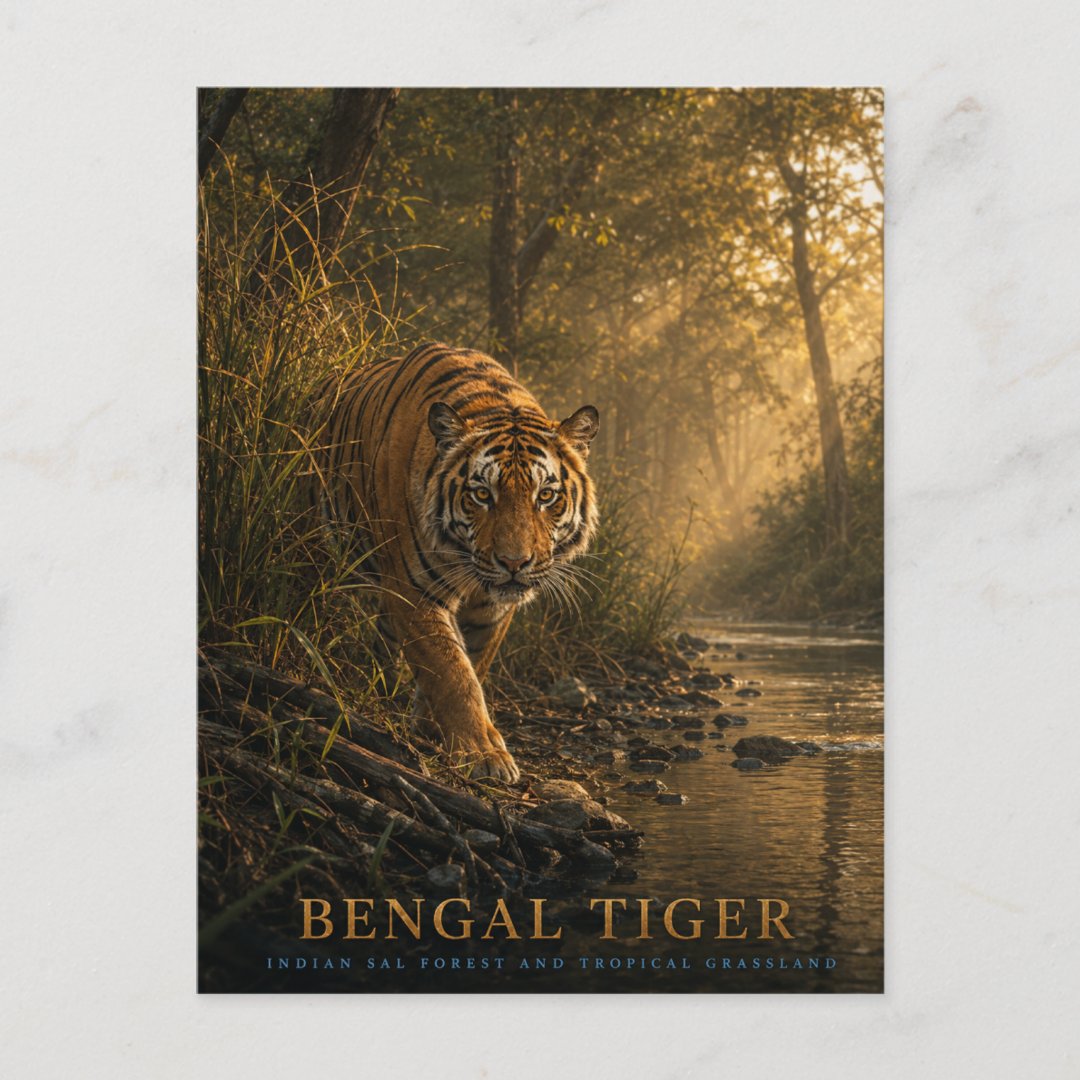
Search “Bengal tiger forest” and you will mostly get a roar, a cub, or stripes with no biology attached. This post is the other version: where a Bengal tiger actually lives, how it hunts in sal and riverine forest, why most of its day is rest, and how to tell one from a lion, a leopard, or another tiger subspecies when the animal is only a shape in the shade. The Bengal Tiger Sal Forest ANIMALS Postcard is one wildlife frame from that story, not the story itself.
The Bengal tiger is not just “the tiger”
The Bengal tiger is Panthera tigris tigris, the tiger of the Indian subcontinent: India, Bangladesh, Nepal, Bhutan, and a thin hold in surrounding country. People treat “tiger” as one animal in a zoo. It is not. A Siberian tiger is a different population, built for cold. A Sumatran is smaller, island-built. The Bengal is the one tied to sal forest, terai grassland, mangrove edge, and the dry forests of central India.
Adults are heavy. A male often weighs 400 to 500 pounds, sometimes more; a female is smaller, commonly 220 to 350. They take years to fill out. A young tiger looks rangy, not like a logo.
Tigers are solitary. A mother with cubs is the social unit you actually see. Males overlap ranges. There is no pride to photograph from a jeep as a group pose.
Sal forest habitat is a job site, not a backdrop
Bengal tigers use a mix: sal and mixed deciduous forest, riverine woodland, tall grassland, mangrove in the Sundarbans. The useful habitat is cover plus prey. Deer, wild pig, gaur where they remain. Water. Shade. A place to drag a kill.
Sal trees are not scenery. They are shade, stalk cover, and the structure of a hunting ground. A dry streambed is a travel line. The postcard pairing of a tiger in dappled forest light is a working map: stripes as broken shade, a body built to wait, then close.
They do poorly where forest is cut into islands and livestock replaces deer. A pretty grove with no chital is a closed kitchen.
Stripes, ambush, and why they rest so much
Tigers are hypercarnivores. The method is stalk and ambush, not a long chase. Stripes break up the outline in vertical stems and slats of light. A failed charge is expensive. Rest is the budget. A tiger lying in sal shade at midday is not lazy. It is between hunts, which is most of the hours.
They kill with a bite, often to the throat or nape, then drag. Water matters. They swim. Sundarbans tigers use tidal forest; inland Bengals use pools and rivers as drink and cool-down, not as a gimmick.
A postcard that only shows a calm walk through sun-slashed trees is not lying. It is showing the hours between kills.
How to tell a Bengal tiger from a lion, a leopard, and other tigers
The stripes are the usual field mark and they are the usual trap if you stop there.
Stripes versus mane versus spots. Tiger: dark stripes on rufous to gold, no mane. Lion: plain tawny, mane on many males, a savanna social cat. Leopard: rosettes, smaller, often in a tree with a kill.
Head and body. A tiger looks long and low, with a ruff and a heavy forequarters. A lion looks taller-headed in the open. A leopard looks compact.
Place. Sal forest, terai, Indian jungle, Sundarbans: Bengal. African savanna: not this cat. A “white tiger” is a rare color morph, usually from captive lines, not a wild Indian type you should expect on a trail.
Other tigers. Siberian: paler, longer coat, Russian Far East. Sumatran: smaller, heavier striping, Indonesia. If you only get a silhouette in forest shade, use stripes and bulk before you bet the farm on a zoo memory of a lion.
The roar and the cub photo versus most of the day
The viral tiger image is a roar, a charge, or a cub in grass. That is real, and it is a sliver. Tigers rest something like 16 to 20 hours a day. Hunting and walking occupy the rest. A roar carries. It is a location and a warning, not a personality.
Cubs stay with the mother more than a year. A male’s range overlaps several females. There is no pack to pose.
If a post or a painting only shows the roar, it is showing the one second people can hear from a vehicle. The animal lives in the other 86,399 seconds, many of them spent on its side in the shade.
Territory, scent, and why forest is a property line
A tiger holds a range. Scent marks, scrapes, and roars maintain it. Territory is about prey, water, cover, and other tigers. The sal forest in the postcard is not empty of politics. It is a property line with leaves on it.
This is why a still Bengal tiger in forest light is not a small subject. The trees are a waypoint in a working hunting system, not a jungle sticker.
Why that body exists
A lion voted for open country and a group. A leopard voted for climbing and a wider menu. A tiger voted for ambush power in cover: heavy forequarters, a long body, stripes that read as stems and light. The whole skeleton voted for the forest job. That is also why a tiger in a tiny enclosure is an animal out of its geometry.
Why the ANIMALS postcard looks the way it does
The Bengal Tiger Sal Forest ANIMALS Postcard is built from that natural history, not from a generic “big cat sunset” template. The tiger is in slatted forest light because that is how an ambush hunter sits in sal: body in shade, stripes as stems. A slightly low view is scale, not drama for its own sake. Leaf litter, trunks, and a path of sun are the job site: prey country with cover a solitary cat can claim.
The type on the card says BENGAL TIGER and SAL FOREST because that is the species and the job site. Wildlife first. Place as the medium it lives in. That is the ANIMALS line: a cinematic still of a real animal in a real kind of shade, meant to be kept, not a stack of SKUs.

Wild Realms makes cinematic wildlife art from the living world. See nature. Feel connection. Cherish forever.
The postcard: Bengal Tiger Sal Forest ANIMALS Postcard
More Bengal tiger wildlife: Tiger collection


Comments
Post a Comment