Snow Leopard Alpine Habitat, Hunting, and How to Tell Them from Other Big Cats
Snow Leopard Alpine Habitat, Hunting, and How to Tell Them from Other Big Cats
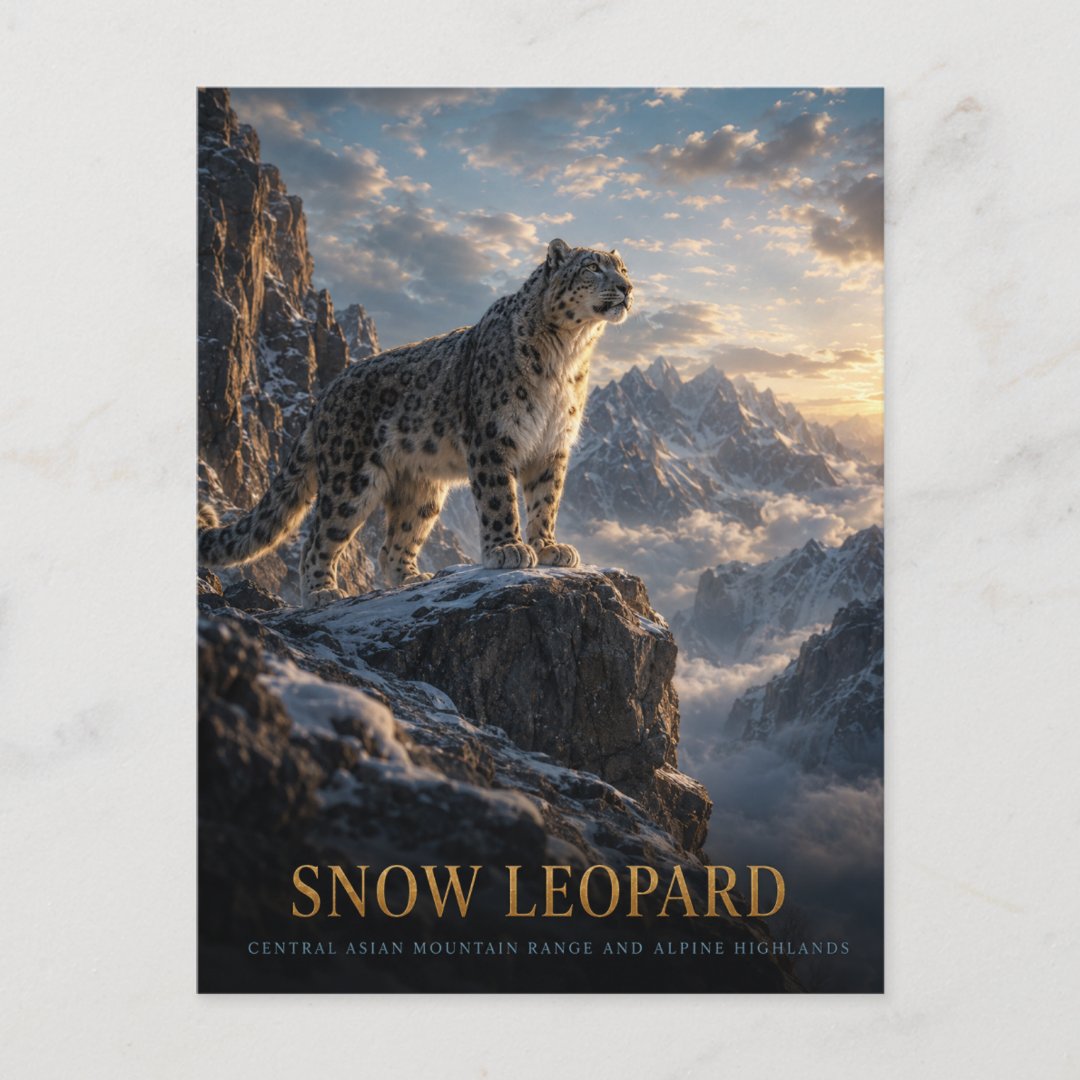
Search “snow leopard mountains” and you will mostly get a stare, a cub in snow, or a spotted cat with no biology attached. This post is the other version: where a snow leopard actually lives, how it hunts on cliffs, why most of its life is unseen, and how to tell one from a leopard or a lynx when the animal is a long way off. The Snow Leopard Alpine Highlands ANIMALS Postcard is one wildlife frame from that story, not the story itself.
The snow leopard is not a leopard that likes snow
The snow leopard is Panthera uncia, a high-country cat of Central Asia’s mountains, not a color morph of the African or Asian leopard. People treat it as a leopard that moved uphill. It is not. The skull is shorter, the nasal opening larger for cold air, the tail extremely long, the hind legs long for leaping. The coat is pale, smoky, with open rosettes that read as rock and snow. If you are waiting for a jungle leopard’s gold before you will say “snow leopard,” you will walk past the real animal.
Adults commonly weigh 60 to 120 pounds, far lighter than a tiger, lighter than many leopards. They look substantial because the fur is thick and the tail is a third of the animal. A two-year-old still has a kitten’s oversized paws.
Snow leopards are solitary hunters that still share ranges and communicate. A pair is not a pride. A mother with cubs is the social unit you actually see.
Alpine habitat is a job site, not a backdrop
Snow leopards use steep, broken country: the Himalaya, Karakoram, Pamir, Tien Shan, Altai, and neighboring ranges. The useful habitat is a mix. Cliffs and scree for stalking. Ridges for travel. Prey that can live at altitude: blue sheep, ibex, argali, markhor, marmots in season. A valley floor is a commute, not a living room.
A ledge is not scenery. It is a lookout, a rest, a drop-off for an ambush. Patchy snow is camouflage and a water source. The postcard pairing of a cat on windswept rock above an immense valley is a working map: height for seeing, stone for stealth, space a solitary hunter can claim.
They do not need rainforest. They do poorly where livestock replaces wild caprids and the cliffs are empty. A pretty peak with no blue sheep is a closed kitchen.
Tail, lungs, and why they hunt in bursts on cliffs
The tail is a balance pole and a blanket. In a leap across broken rock it steers. At rest it wraps the face against cold. The chest is deep for thin air. The paws are wide. This is a cat that jumps more than it runs a marathon.
They are hypercarnivores. Typical prey is mountain ungulates; they also take marmots, hares, and birds. The method is stalk, close, burst, often downhill. A failed leap is expensive. Rest is the budget. A snow leopard standing still on a ledge at first light is often working: watching the slope, not posing.
They cannot roar like a lion or a tiger. They chuff, yowl, and leave scent. The silence people love in photos is also the communication system: marks on rock, not a soundtrack.
How to tell a snow leopard from a leopard, a lynx, and a puma
The spots are the usual field mark and they are the usual trap.
Rosettes and ground color. Snow leopard: pale gray to cream, open smoky rosettes, dark spots on the limbs. Leopard: gold to tawny, tighter rosettes, a jungle or woodland cat. If the animal looks dipped in fog, think snow leopard. If it looks like sunlight on leaves, think leopard.
Tail and legs. Snow leopard tail is very long, thick, and often curled. Hind legs look long. A lynx has a bobbed tail and ear tufts. A puma is plain, no rosettes, a different continent.
Face. Short muzzle, small rounded ears, a forehead that looks wide. No black ear-backs like a lynx. No tear streak like a cheetah.
Place. High Asia, steep rock, thin air. A spotted cat in a tropical tree is not this species. A spotted cat on a Himalayan scree slope probably is.
If you only get a silhouette on a ridge at dawn, use tail length and the slope before you bet the farm on a zoo memory of a leopard.
The stare and the cub photo versus most of the life
The viral snow leopard image is a direct stare, or a cub in a photographer’s dream light. That is real, and it is a sliver. Snow leopards rest a large part of the day. Stalking, moving ridges, and feeding occupy the rest. They are famously hard to see. That is not mystique as a brand. It is what a camouflaged, cliff-hunting cat does.
Cubs are born in a rocky den and stay with the mother more than a year. A male’s range overlaps several females. There is no pride to photograph from a vehicle.
If a post or a painting only shows the stare, it is showing the one second a camera got lucky. The animal lives in the other 86,399 seconds, many of them spent as a pale shape against stone.
Range, solitary travel, and why “ghost” is a job description
A snow leopard’s range can be tens to hundreds of square miles of vertical country. They patrol ridgelines, drop into a valley for a hunt, climb out. Scent marks and scrapes are the mailbox. The alpine highlands in the postcard are not empty of politics. They are a property line with scree on it.
This is why a still snow leopard on a ledge is not a small subject. The ledge is a waypoint in a working hunting system, not a mountain sticker.
Why that body exists
A lion voted for open-country power and a group. A leopard voted for trees and a wider menu. A snow leopard voted for thin air, broken rock, and a tail that can steer a leap. Thick fur, wide paws, small ears: heat-keeping on a cliff. The whole skeleton voted for the alpine job. That is also why a snow leopard on a flat zoo floor is an animal out of its geometry.
Why the ANIMALS postcard looks the way it does
The Snow Leopard Alpine Highlands ANIMALS Postcard is built from that natural history, not from a generic “pretty cat in snow” template. The cat is on a windswept ledge because that is a real lookout and rest site, not because rock photographs well. First light is when the valley still holds shadow and the animal actually moves. Ridgelines, patchy snow, and far peaks are the job site: prey country with a horizon a solitary hunter can claim.
The type on the card says SNOW LEOPARD and ALPINE HIGHLANDS because that is the species and the job site. Wildlife first. Place as the medium it lives in. That is the ANIMALS line: a cinematic still of a real animal in a real kind of cold, meant to be kept, not a stack of SKUs.
Wild Realms makes cinematic wildlife art from the living world. See nature. Feel connection. Cherish forever.
The postcard: Snow Leopard Alpine Highlands ANIMALS Postcard
More snow leopard wildlife: Snow Leopard collection


Comments
Post a Comment