A Bull Shark Bit a Diver Off Pensacola — So Why Does Everyone Still Say Great White?
A Bull Shark Bit a Diver Off Pensacola — So Why Does Everyone Still Say Great White?
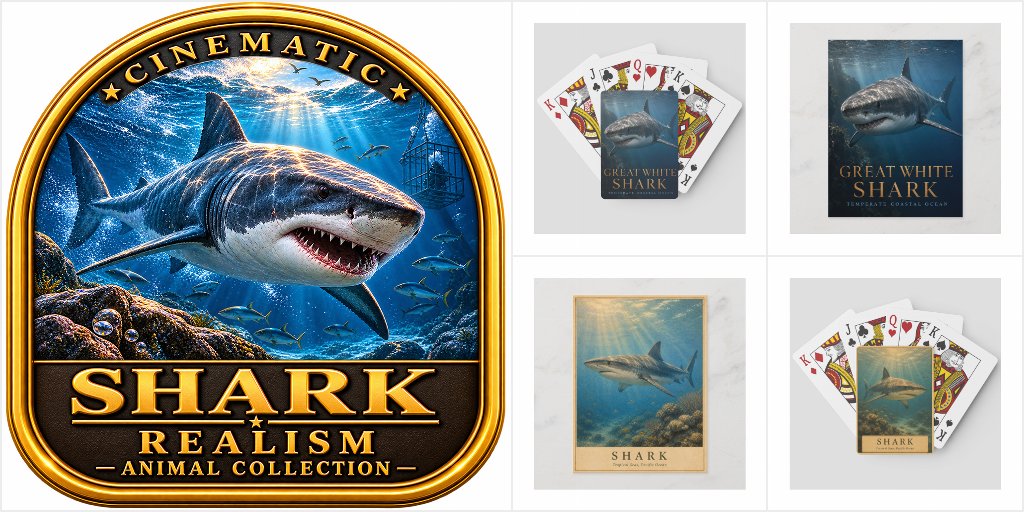
Off Pensacola this week, a bull shark tore into a diver’s forearms about 30 miles offshore — Coast Guard response, LifeFlight to Sacred Heart, a captain shoving his friend back into the boat. The wire called it a shark attack, and half the replies still typed great white. Wrong species. Wrong body plan. This post is what that headline is actually about: how to tell a coastal bull from a temperate great white, and why the mix-up keeps happening. The Great White Shark Coastal Ocean ANIMALS Postcard is one wildlife frame of the animal people thought they were naming — so the difference stays visible.

The great white is not a movie villain that lives in the middle of nowhere
The great white shark is Carcharodon carcharias, the largest living mackerel shark and the only living member of its genus. People treat “shark” as one gray torpedo with extra teeth. It is not. A great white is a coastal apex hunter with a conical snout, a crescent tail, a white belly you can actually see, and a habit of showing up where seals, sea lions, and fish concentrate — islands, headlands, continental shelves — not in the blank middle of an ocean basin because a script needs a scare.
Adults commonly reach 13 to 16 feet, with large females larger still, and can weigh more than a ton. They mature slowly, often in their teens, and may live 70 years or more. That long clock matters. A shark photographed off California or South Africa may have been using the same coastal circuit since before the cage-dive boats wrote the brochure.
They are lamnids, cousins of makos, with regional endothermy: warm swimming muscle, a warm eye and brain. Cold temperate water is operating temperature, not a hardship costume.
Coastal ocean is a hunting ground, not a backdrop
The open-ocean myth is stubborn because the animal is large and the sea is large. Satellite tags tell a less cinematic story. Great whites use coastal and nearshore waters as the kitchen: seal colonies, rocky islands, the edges of continental shelves, places where prey is dense enough to repay a large, warm-bodied hunter. Guadalupe, the Farallones, False Bay, the Neptune Islands — those names keep coming up because the food is there.
They do make offshore legs. Some populations show seasonal shuttles into more pelagic water, including the much-mapped “White Shark Café” between Baja and Hawaii, where the job still looks like feeding and social business, not aimless roaming. The commute does not cancel the coast. It is a hunter that can cross open water and then go back to work where pinnipeds haul out.
Sunlit blue, a dark reef wall, and a shark coming out of the gloom is a feeding map. Countershading only pays if there is a surface above you and prey that looks down. A pretty empty abyss with nothing to hunt is a closed kitchen.
Teeth, heat, and why the body is a hunting machine
The mouth is the usual obsession and it is only one tool. Upper teeth are broad, triangular, and coarsely serrated — a saw for cutting chunks from large prey. Lower teeth are narrower, more stabbing. The bite is not a nibble and it is not random. A first contact can be investigative. A feeding bite on a seal is a different decision. Failed hunts are expensive. A warm-bodied shark in cool water has a metabolic bill.
The rest of the machine is easier to miss. The caudal fin is a crescent propeller, not the uneven tail of a nurse shark on sand. Denticles let water slide. The liver is an oil tank for buoyancy and energy. Ampullae of Lorenzini read faint electric fields. A shark approaching from below, slightly agape, is often in the last seconds of a calculation, not posing.
Diet shifts with size. Young whites take fish, rays, other sharks. Larger animals add marine mammals. That is why a coastal seal colony is not scenery. It is a restaurant with a waiting list.
How to tell a great white from other sharks
The triangular dorsal is the usual field mark and it is the usual trap. A lot of sharks have one.
Color and shape. Great white: dark gray to gray-brown above, sharply white below, a stout torpedo, a conical snout, black eyes, a crescent tail. Tiger shark: blunt snout, stripes or bars that fade with age, a more scalloped look, different teeth. Shortfin mako: slimmer, metallic blue, a speed specialist, less of that heavy white belly contrast. Bull shark: shorter, thicker, a more rounded snout, often in murky estuaries and rivers a white would not commute to as a lifestyle.
Place and behavior. A large shark working a temperate seal island is a white until the body says otherwise. A shark in a tropical lagoon over coral is usually not. Whale sharks and basking sharks are the easy outs: filter feeders, different mouths, different jobs. Orcas have teeth and a tall fin and are not sharks.
If you only get a silhouette against surface glare, use the white belly, the conical snout, and the crescent tail before you bet the farm on a movie theme.
The breach and the cage-dive versus most of the day
The viral great white image is a full-body breach on a seal, or a snout against a cage. That is real, and it is a sliver. Breach hunting is famous at a few sites, especially where seals cross deep water near a slope. Most hunting is not a jump for the cameras. It is approach from below, a rush, a miss, another try, or a scavenged whale carcass that draws a crowd. Hours are spent traveling, waiting, and being a dark shape under a swell.
They are not school fish. Individuals overlap at feeding sites. There is no pack and no villain arc. Females are live-bearing; pups are born large and already hunting.
If a post or a painting only shows the breach, it is showing the two seconds people can film from a boat. The animal lives in the other 86,398 seconds, many of them spent as a countershaded shape in coastal blue, commuting between a seal colony, a shelf edge, and the next meal that justifies the furnace.
Range: coastal circuits, not a random ocean wander
Great whites occur in temperate and subtropical coastal waters in both hemispheres: California and Mexico, the U.S. East Coast, South Africa, Australia and New Zealand, other shelves where prey lines up. They are not tropical reef mascots. The useful map is a set of hunting grounds tied by travel.
Site fidelity is real. Researchers photo-ID dorsal fins the way whale people photo-ID flukes. A “mystery shark” off a beach is often a known commuter, not a new monster from the abyss.
This is why a still great white in sunlit coastal water, with a reef wall in the frame, is not a small subject. The blue is a waypoint in a working hunting system, not a blank studio cyclorama.
Why that body exists
A tiger shark voted for a wide tropical menu. A mako voted for pelagic speed. A great white voted for warm muscle in cool coastal water, a cutting bite, and a shape that can come from below a seal and still cross open ocean when the calendar says move. Countershading, a lunate tail, an oil-rich liver, an electrical sense: the kit of a hunter that uses the coast as a job site. That is also why a great white in a lagoon exhibit is an animal out of its geometry.
Why the ANIMALS postcard looks the way it does
The Great White Shark Coastal Ocean ANIMALS Postcard is built from that natural history, not from a generic “jaws in empty blue” template. The shark comes in on a diagonal, slightly agape, because that is a real hunting approach from below, not because teeth photograph well. A near-water-column view is how prey actually meets this animal: light from the surface, a white belly flashing, pectorals set, the body between you and the sun. Shafts in the water and a dark reef wall are the job site, not the middle of a featureless basin.
The type on the card says GREAT WHITE SHARK and TEMPERATE COASTAL OCEAN because that is the species and the job site. Wildlife first. Place as the medium it lives in. That is the ANIMALS line: a cinematic still of a real animal in a real kind of water, meant to be kept, not a stack of SKUs.
Wild Realms makes cinematic wildlife art from the living world. See nature. Feel connection. Cherish forever.
The postcard: Great White Shark Coastal Ocean ANIMALS Postcard
More great white shark wildlife: Shark collection


Comments
Post a Comment