Brazil Humpbacks Near 35,000 Again, The Open Ocean Job Behind the Comeback
Brazil Humpbacks Near 35,000 Again, The Open Ocean Job Behind the Comeback
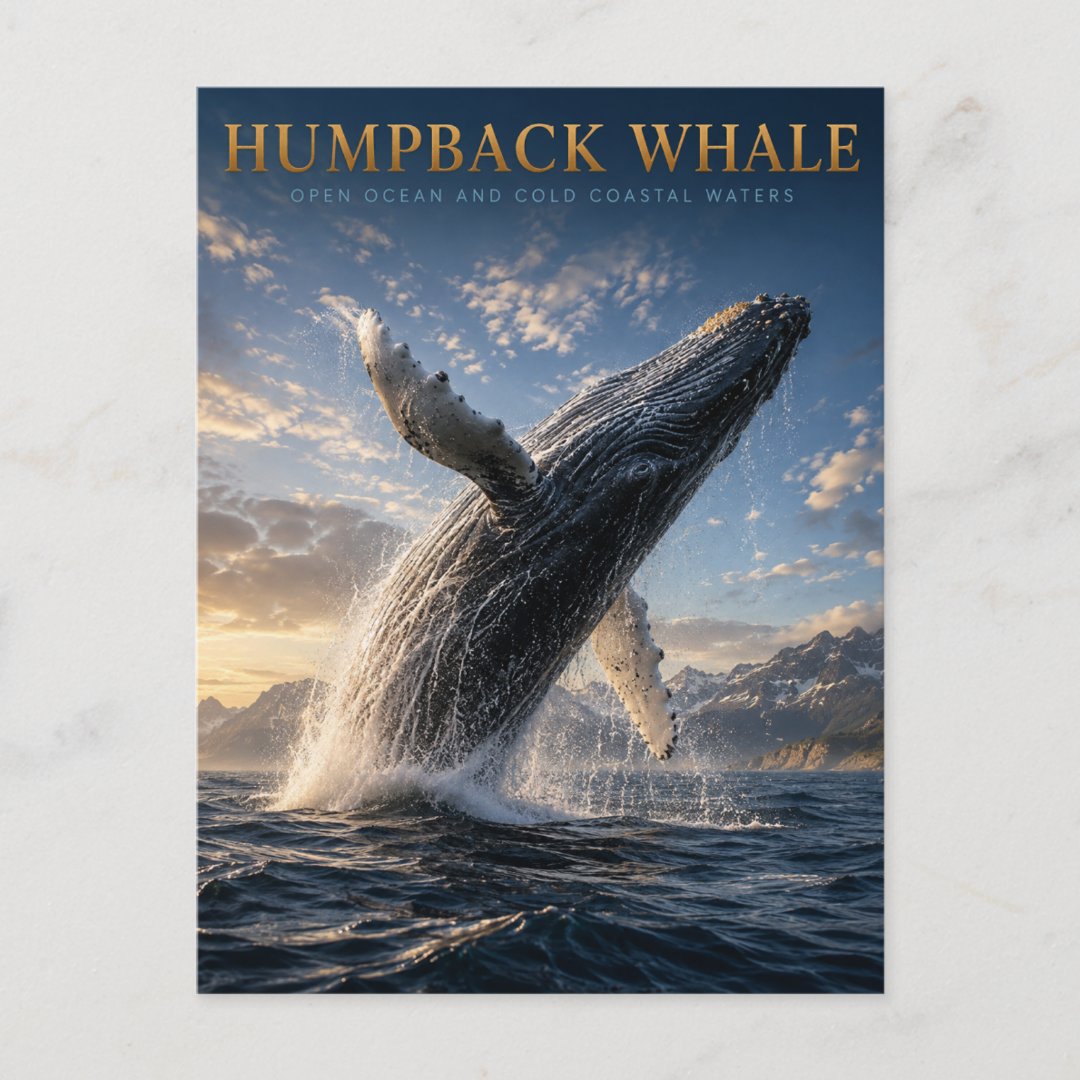
Brazil’s South Atlantic humpbacks are back in the news this season as counts climb toward roughly 35,000 after commercial whaling once left only a few thousand, and whale-watch boats off Rio are suddenly part of the civic argument: tourism as witness versus tourism as pressure. Sightings inside Guanabara Bay have even made local wires. This post is what that recovery headline sits on: how a humpback actually uses cold kitchens and warm nurseries, why a breach is a sliver of the day, and how to tell this rorqual from the lookalikes when the only honest frame left is biology. The Humpback Whale Open Ocean ANIMALS Postcard is one wildlife frame from that commute, not a cruise brochure.
The humpback is not a generic whale with extra splash
The humpback whale is Megaptera novaeangliae, a rorqual whose Latin name is almost a field guide: large-winged New Englander. The “wings” are the pectoral fins, the longest of any whale, often about a third of the body. People treat “whale” as one dark back. It is not. A humpback is a gulp-feeder with knobs on the snout, a small dorsal set far back on a humped roll, and a tail researchers can ID like a fingerprint.
Adults commonly reach 40 to 50 feet and 25 to 40 tons, with females often larger than males. A calf is already the size of a small car and still dependent. Humpbacks are not a pod in the orca sense. They travel, feed, and breed in looser associations. Mothers with calves are the social unit you can count on. Males sing. That is work, not a choir for tourists.
Open ocean is a job site, not a backdrop
Humpbacks use two kinds of water in one year, and the postcard is the commute between them. High-latitude feeding grounds are the kitchen: cold water full of krill and small schooling fish. Tropical breeding grounds, including Brazil’s Abrolhos Bank and other warm coasts, are the nursery. Southern Hemisphere animals that feed near the Antarctic can travel on the order of 4,000 kilometers to Brazilian winter water. The useful habitat is food they can gulp and a surface they can break for air, a look, or a slap.
A swell is not scenery. It is the medium a 40-ton animal lives in. Distant coastline and mountains are the edge of a feeding or transit range, not a souvenir. The postcard pairing of a whale above rolling blue water, with spray and a far shore, is a working map: air at the top of the leap, food somewhere below, a horizon a migrant can cross.
They do poorly where ship traffic, nets, and noise erase the commute between kitchen and nursery. A pretty tropical lagoon with no path back to the feeding ground is a closed kitchen. Recovery numbers look like a victory parade. The body still has to cross shipping lanes to earn them.
Baleen, throat pleats, and why they gulp instead of bite
Humpbacks have no teeth as adults. They have baleen: keratin plates hanging from the upper jaw, fringed on the inner edge like a comb. The method is lunge feeding. The mouth opens, the throat pleats expand into a huge pouch, water and prey go in, the mouth closes, and the water leaves through the baleen. What stays is krill, herring, capelin, or sand lance, depending on the ocean. It is not a nibble. It is a building taking a drink.
Some populations add a tool. Bubble-net feeding is a cooperative ring of bubbles that herds prey, then a lunge up through the column. Not every humpback does it. Failed lunges are expensive. Rest at the surface is the budget. On the breeding grounds they eat little for weeks. The fat they built in cold water is the fuel. That is why a tropical postcard whale can look idle. It is living on last season’s kitchen.
How to tell a humpback from other whales
The breach is the usual field mark and it is the usual trap if you never see the body at rest.
Pectoral fins. Humpback pectorals are absurdly long, often white or mottled underneath, and they slap. Other rorquals have shorter, more reasonable arms. If the “wing” looks like a door, think humpback.
Head and dorsal. Knobs on the snout and lower jaw. A low, stubby dorsal set far back on a roll of back that actually does hump before a dive. A blue whale’s head is a broad U; a fin whale is a long gray knife. Right and bowhead whales have no dorsal fin.
Flukes. A humpback often lifts the whole tail on a deep dive. The underside is uniquely patterned, which is how catalogs of individuals get built. Gray whales have a knuckled back and no true dorsal. Orcas have teeth and a tall male fin.
Song is a male breeding-ground behavior. A blow at sea is not a species ID by itself. If you only get a silhouette against morning spray, use the long pecs and the humped roll before you bet the farm on a movie breach.
Mobbing orcas is another real behavior, not a mascot story
Separate from the Brazil count, researchers compiling decades of encounters have documented humpbacks approaching mammal-eating killer whales that are already attacking other prey, including seals and even other whale calves. The pattern looks like mobbing: harassment that sometimes lets the prey escape. Only a minority of those cases involve humpback calves as the target. Scientists are careful about the word altruism. The useful takeaway for a reader is simpler: humpbacks are not passive scenery. They are large, expensive animals that sometimes spend energy confronting predators even when the animal under attack is not their own calf.
The breach and the whale-song video versus most of the day
The viral humpback image is a full-body breach, or a soundtrack of moans in a spa playlist. That is real, and it is a sliver. Humpbacks spend most of their lives underwater. Travel, feeding lunges, rest, and the quiet logistics of a calf occupy the hours. A breach can be play, display, parasite-shedding, or a look. It is a decision, not a personality.
Song is more specialized. On breeding grounds, males produce long, structured sequences that can last many minutes and be heard for miles. The songs change over a season. Animals in the same ocean tend to share a version, then the version drifts. It is not a serenade aimed at your boat. If a post or a painting only shows the breach, it is showing the two seconds people can film from a rail. The animal lives in the other 86,398 seconds, many of them spent as a dark shape under a swell, moving toward the next gulp or the next latitude.
Migration: cold kitchen, warm nursery, long commute
Humpbacks are among the long-distance champions of mammal travel. After months of feeding in high latitudes, many populations swim thousands of miles to winter breeding water. Hawaii and Alaska are the usual Northern Hemisphere textbook pair. In the South Atlantic, Antarctic feeders and Brazilian breeders form another working circuit. Males show up to sing and compete. A calf is born in water, nurses, and has to make the return trip before it has a working kitchen of its own. Photo-ID of flukes is how we know individuals actually do this. That is why a still humpback over open ocean is not a small subject. The water is a waypoint in a working migration system, not a cruise backdrop.
Why the ANIMALS postcard looks the way it does
The Humpback Whale Open Ocean ANIMALS Postcard is built from that natural history, not from a generic “happy splash” template. The whale is almost clear of the water because that is a real, rare second in a life of commuting, not because jumping photographs well. A near-water-level view is scale: body, spray, and an ocean still larger than the leap. Rolling swells, a rugged far coastline, and an immense sky are the job site. Bright morning light is when wet skin and mist actually show.
The type on the card says HUMPBACK WHALE and OPEN OCEAN because that is the species and the job site. Wildlife first. Place as the medium it lives in. That is the ANIMALS line: a cinematic still of a real animal in a real kind of water, meant to be kept, not a stack of SKUs.
Wild Realms makes cinematic wildlife art from the living world. See nature. Feel connection. Cherish forever.
The postcard: Humpback Whale Open Ocean ANIMALS Postcard
More humpback whale wildlife: Whale collection


Comments
Post a Comment