CPW Kills a Third Wolf This Week After Grand County Livestock Depredation, What Gray Wolf Pack Life Is Built For
On coverage published Friday, September 11, 2026, in the Grand Junction Sentinel, Colorado Parks and Wildlife agents lethally removed an uncollared female yearling from the One Ear Pack in Grand County on Wednesday, September 9 — the third wolf killed this week after continued livestock depredation during an evaluation period that followed an August 4 removal from the same pack, and after producers had used available non-lethal deterrents. That is the Rockies wire. This post is what that headline sits on: how gray wolf packs actually live, travel, and hunt, why livestock edges are a biology problem as much as a politics problem, and how mountain wilderness still names the job the body is built for. The Gray Wolf Mountain Wilderness ANIMALS Postcard is one wildlife frame from that story, not a CPW removal brief.
The gray wolf is not a big coyote with better PR
The gray wolf is Canis lupus, the large pack-hunting canid of the Northern Hemisphere: longer legs relative to body than a coyote, a broader muzzle, a tail that usually hangs rather than curls high, and a social brain built for coordinated chase. Coyotes are Canis latrans: smaller, more solitary or pair-based in many landscapes, a different prey menu and a different political temperature. Domestic dogs share ancestry with wolves but not the same wild commute.
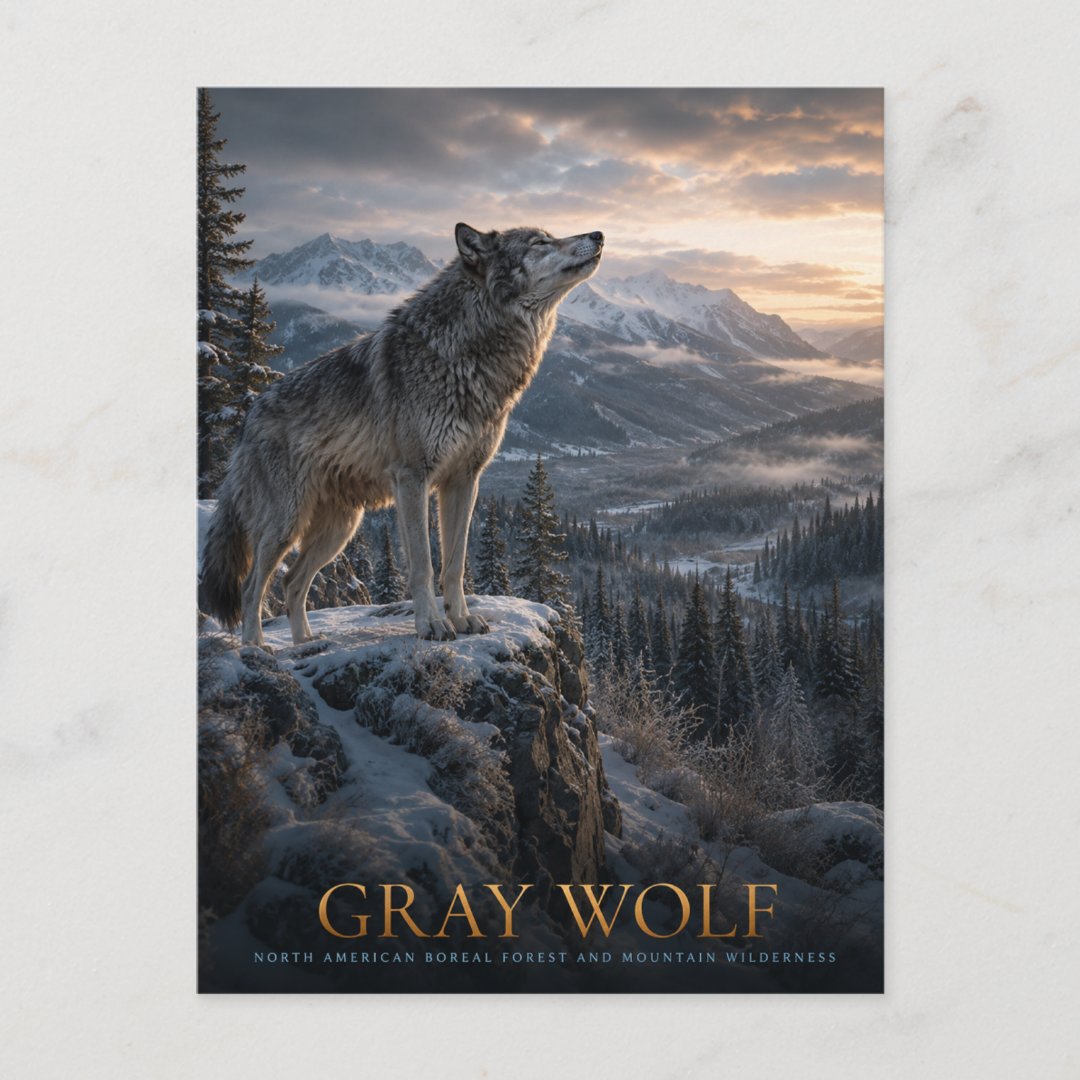
People mash “big wild dog” into one comment-thread sticker. That is how a yearling on a cattle allotment and a Yellowstone tourism howl get treated as the same animal story. They are related. They are not interchangeable. The postcard is a mountain-wilderness frame: snow light, timber edge, a body built to travel and take large ungulates when the pack holds together.
Mountain wilderness is a job site, not a logo
A wolf’s workplace is prey within a territory the pack can defend and travel: elk, deer, moose calves in some ranges, smaller mammals when large kills are scarce, and the snow or mud that records every commute. Useful habitat is food plus room to move without constant livestock collision. Timber, ridges, and valley floors are the other characters in the frame — they set scent posts, day beds, and chase lines.
A soft edge is ungulate country with depth. A hard edge is pasture flush against a packs travel map, where calves and sheep sit inside the same nose-range as elk. The postcard’s mountain wilderness is the soft-edge ideal against which pasture friction looks like a hard commute, not a cartoon howl.
Packs, yearlings, and livestock as learned maps
Gray wolves live in family packs: a breeding pair, offspring of several ages, sometimes unrelated joiners. Yearlings are apprentices. They hunt, travel, and test boundaries. When a pack finds easy protein on a ranch edge, that pattern can stick the way any successful hunt sticks scent, timing, and a yearling copying adults.
Livestock conflict is behavior meeting architecture. Fladry, range riders, carcass cleanup, and night penning try to rewrite the edge before a chase becomes a habit. Lethal removal targets a learned commute; packs reshuffle and new yearlings grow into the same map. Most hours of a wolf year are still travel, rest, scent-marking, and wild ungulate hunts that fail more often than tourism footage admits.
How to tell a gray wolf from a coyote (and from a husky in a viral clip)
Size and muzzle. Wolves are larger, with a blockier snout and broader head. Coyotes look fox-lean by comparison. Phone zoom lies; ask for a scale object.
Tail and ears. Wolf tails tend to hang; coyote tails often show more bounce and a different carriage. Ears on coyotes can look oversized for the head.
Tracks and gait. Wolf tracks are larger; the direct-register trot of a traveling wolf is a different sentence from a coyote’s lighter print train. Do not caption a husky video as either.
Why that body exists
A cougar voted for solo ambush and a different skull. A coyote voted for flexibility and smaller prey. A gray wolf voted for pack coordination, distance legs, and jaws that can hold a large ungulate long enough for help to arrive. That is why a yearling on a Colorado allotment and a wolf in mountain snow share one job description under different management weather — and why treating every wolf story as only a removal scorecard erases the commute the postcard is meant to hold.
Why the ANIMALS postcard looks the way it does
The Gray Wolf Mountain Wilderness ANIMALS Postcard is built from gray wolf natural history, not a removal diagram and not a generic “wild dog” template. The wolf stands in mountain wilderness light because that is the job: distance, timber, cold air, a body tuned to chase and pack space. A cinematic still is presence and habitat, not a livestock-conflict freeze for its own sake.
If a Rockies trip story needs a town name beside the wildlife frame, Supreme Customs keeps destination cards when the postcard should say place instead of predator.
Wild Realms makes cinematic wildlife art from the living world. See nature. Feel connection. Cherish forever.
The postcard: Gray Wolf Mountain Wilderness ANIMALS Postcard
More wolf wildlife: Wolf collection


Comments
Post a Comment