Emperor Penguin Antarctic Ice Habitat, Colony Life, and How to Tell Them Apart
Emperor Penguin Antarctic Ice Habitat, Colony Life, and How to Tell Them Apart
Search “emperor penguin Antarctica” and you will mostly get a huddle, an egg on feet, or a tuxedo with no biology attached. This post is the other version: why a colony on winter ice is a sliver of the year, how most of an emperor’s life is foraging at sea, and how to tell this species from a king, an Adélie, or a chinstrap when the ice is crowded and the light is low. The Emperor Penguin Antarctic Ice ANIMALS Postcard is one wildlife frame from that story, not the story itself.
The emperor is not “the penguin” in a shared tuxedo
The emperor penguin is Aptenodytes forsteri, the largest living penguin and one of two giants in its genus. People treat “penguin” as one black-and-white bird that shuffles for cameras. It is not. An emperor is an Antarctic sea-ice specialist with a black head, pale yellow-gold neck patches, a long body, and a pink-to-orange mandibular stripe along the lower bill. A king penguin is a cousin in the same genus and a different job: subantarctic islands, no winter huddle on fast ice. If you are waiting for a generic tuxedo before you will name the species, you will walk past the field marks that actually work.
Adults commonly stand about 3.5 to 4 feet and weigh 50 to 90 pounds, heavier before a fast, lighter after. That swing is the budget of a bird that incubates through polar night, then forages in water that would stop an unprepared mammal in minutes. They are colonial at the breeding site and pelagic the rest of the time. A colony is a seasonal factory on ice, not a town they live in.
Antarctic ice is a job site, not a backdrop
Emperors breed on fast ice around the Antarctic coast, with a few sites on ice shelves. The useful habitat is ice stable enough to hold a colony through winter, close enough to open water that adults can feed, and a shelf or polynya that does not maroon them. After breeding, they use the Southern Ocean: pack ice, ice edges, deep water over the shelf and slope.
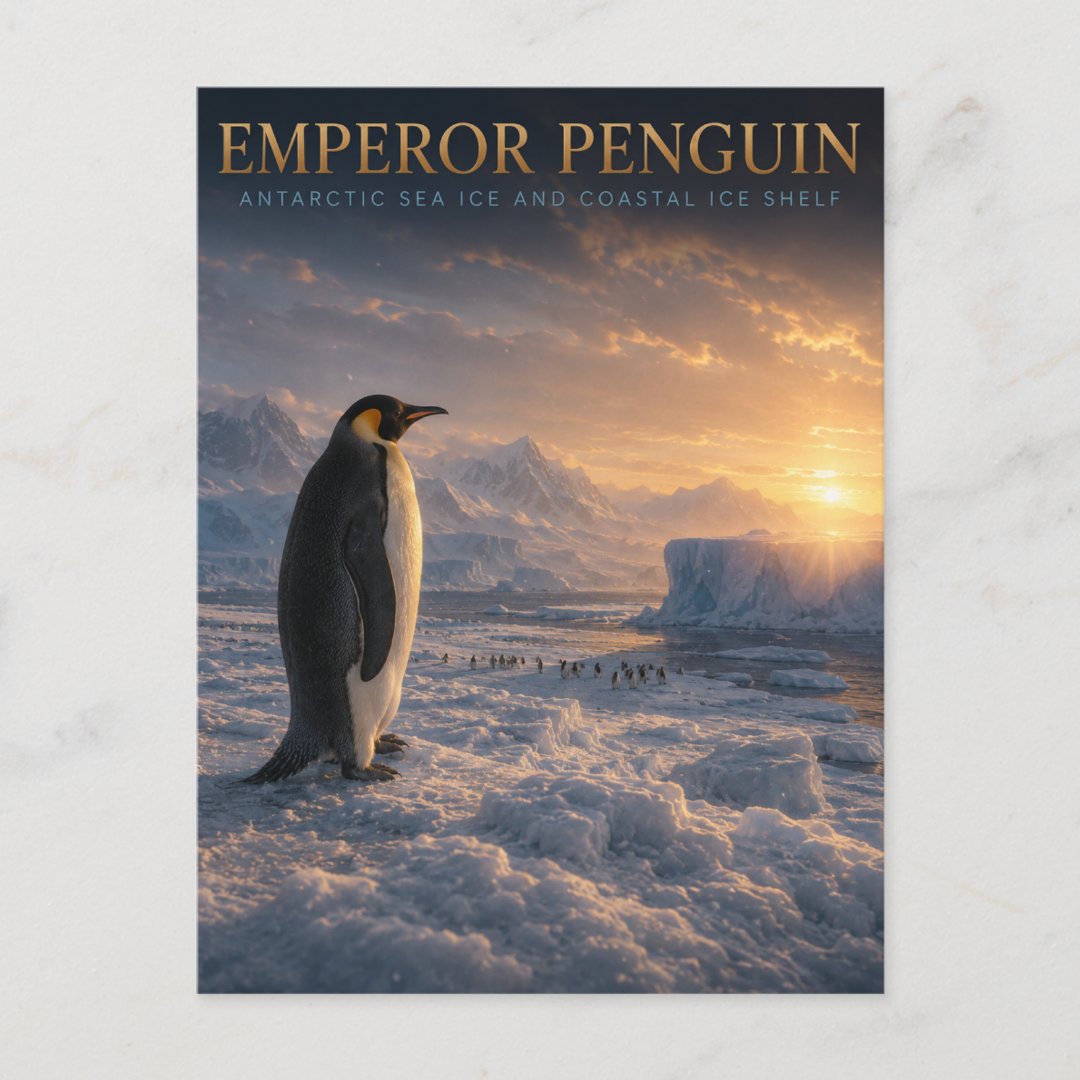
A flat of snow and blue-shadowed ice is not scenery. It is a nursery floor with no nest material. Emperors do not pile stones like Adélies. The egg sits on the feet, under a brood pouch. Ocean at the ice edge is the commute. The postcard pairing of one bird on textured ice, a small group farther off, dark water to the side, and a shelf of ice and peaks behind, is a working map: colony space, a road to the sea, a horizon a diver can return from.
If the fast ice breaks out too early, chicks are in the wrong room. If the ice never forms, there is no factory floor. That is habitat mechanics, the same as a seal hole in polar bear country. A pretty iceberg with no access to fish is a closed kitchen.
Diving, salt, and why they commute from ice to deep water
Emperors eat fish, krill, and squid. Antarctic silverfish show up often. They are among the deepest-diving birds: routinely hundreds of feet, sometimes deeper. The body is a torpedo. The wings are flippers. Bones are denser than a flying bird’s. A salt gland handles seawater. The plumage is a waterproof overlapping of small feathers, not a metaphor.
A trip from colony to water can be a walk of miles if the ice edge has moved. Then the work starts below. They hunt in darkness as well as light. Polar night is not a pause button. Failed dives are expensive. Rest on the ice between trips is the budget, which is why a still bird in profile, looking toward water, is often between shifts, not posing.
How to tell an emperor from other penguins
The tuxedo is the usual field mark and it is the usual trap. Almost all of them have one.
Size and neck color. Emperor: largest, yellow-gold on the neck and upper breast, a more peach-to-orange bill stripe, a black head that meets the gold in a clean sweep. King: similar pattern, usually brighter orange ear patches, a more vivid orange on the bill, smaller, and — the habitat tell — on tussock islands like South Georgia, not on Antarctic fast ice in winter. If the bird is on a subantarctic beach with albatrosses, think king first.
The smaller Antarctic penguins. Adélie: white eye ring, all-black head, smaller, stone nests, a different comedy. Chinstrap: a black line under the chin, as advertised. Gentoo: a white patch behind the eye and an orange bill. Macaroni and other crested penguins are the easy outs once you see the eyebrows.
An emperor chick is silver-gray with a black-and-white face, on ice. A king chick is brown. If you only get a silhouette on sea ice at low sun, use bulk, the gold neck, and the Antarctic fast-ice setting before you bet the farm on a cartoon tuxedo.
The huddle and the egg-on-feet versus most of life at sea
The viral emperor image is a winter huddle, a chick on feet, or a long shuffle in a documentary. That is real, and it is a sliver. Breeding is a winter job on ice, in weather that would end the shoot. Males take the first long incubation fast while females return to sea to feed. The huddle is a heat engine: birds rotate, the interior is warmer, the edge is work. It is not a choir. It is thermodynamics with flippers.
Then the year continues. Adults forage. Chicks fledge and go to sea. Most of an emperor’s life is swimming and diving, not standing in a crowd. A bird alone in profile on ice, with open water in the frame, is often the truer still: the commute between factory and kitchen.
If a post or a painting only shows the huddle, it is showing the weeks people find epic. The animal lives in the other months as a diving hunter in the Southern Ocean, coming back to ice when the calendar and the colony demand it.
Colony, commute, and the winter breeding calendar
Colonies are traditional; birds return; counts change with ice. There is no nest to inherit, only a site that still has a floor. Courtship, egg, hatch, crèche, fledging — the sequence is tight because winter does not wait. Both parents feed once the female returns. A chick in a crèche is in daycare while adults make the water trip.
At sea they are hunters, not a marching column. Satellites and time-depth recorders are how we know the commute is real. That is why a still emperor on Antarctic ice, with a thin colony in the distance and water to the right, is not a small subject. The ice is a waypoint in a working breeding-and-foraging system, not a snow globe.
Why that body exists
An Adélie voted for stones and summer colonies. A king voted for ice-free islands. An emperor voted for the Antarctic winter: mass enough to fast, a brood pouch instead of a nest, a huddle instead of a burrow, and a diving body that can pay the bill in cold, dark water. Dense bones, flipper wings, a salt gland, a dry-suit of feathers: the kit of a bird that uses sea ice as a factory floor and the ocean as the living room. That is also why an emperor on a temperate zoo beach is an animal out of its geometry.
Why the ANIMALS postcard looks the way it does
The Emperor Penguin Antarctic Ice ANIMALS Postcard is built from that natural history, not from a generic “cute tuxedo” template. One adult stands in profile on textured ice because that is a real working second between colony and water, not because a huddle is harder to crop. Eye-level is how the bird sits in its job site: you are on the floor with it, not looking down at a mascot. A small group farther off is the colony as it reads at distance — dark marks on white. Open water, icebergs, and a far ice shelf in low sun are the commute. Golden light is when the neck patch and the blue shadows in the ice actually show.
The type on the card says EMPEROR PENGUIN and ANTARCTIC SEA ICE AND COASTAL ICE SHELF because that is the species and the job site. Wildlife first. Place as the medium it lives in. That is the ANIMALS line: a cinematic still of a real animal on a real kind of ice, meant to be kept, not a stack of SKUs.
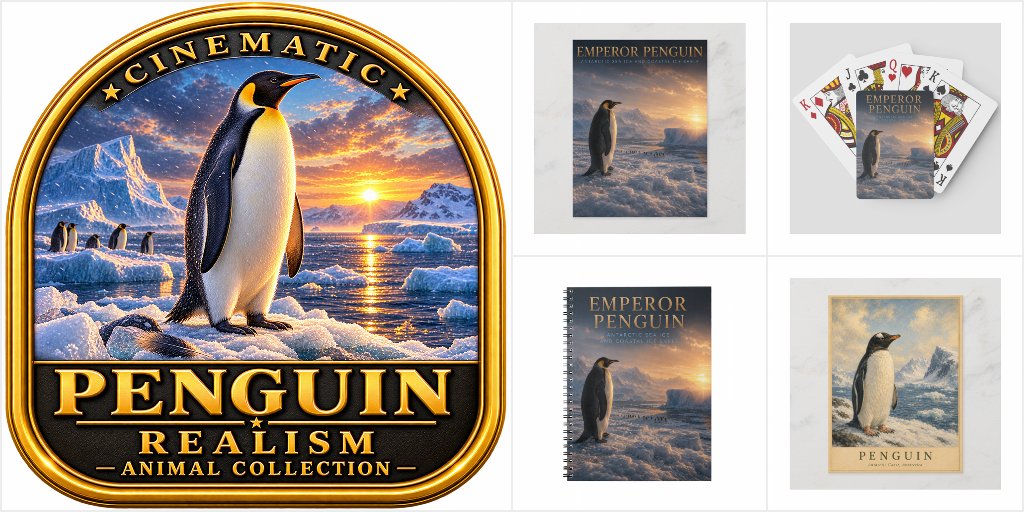
Wild Realms makes cinematic wildlife art from the living world. See nature. Feel connection. Cherish forever.
The postcard: Emperor Penguin Antarctic Ice ANIMALS Postcard
More emperor penguin wildlife: Penguin collection


Comments
Post a Comment