Coral reefs are running out of recovery time between bleachings — here’s the turtle that lives on that job site
Coral reefs are running out of recovery time between bleachings — here’s the turtle that lives on that job site
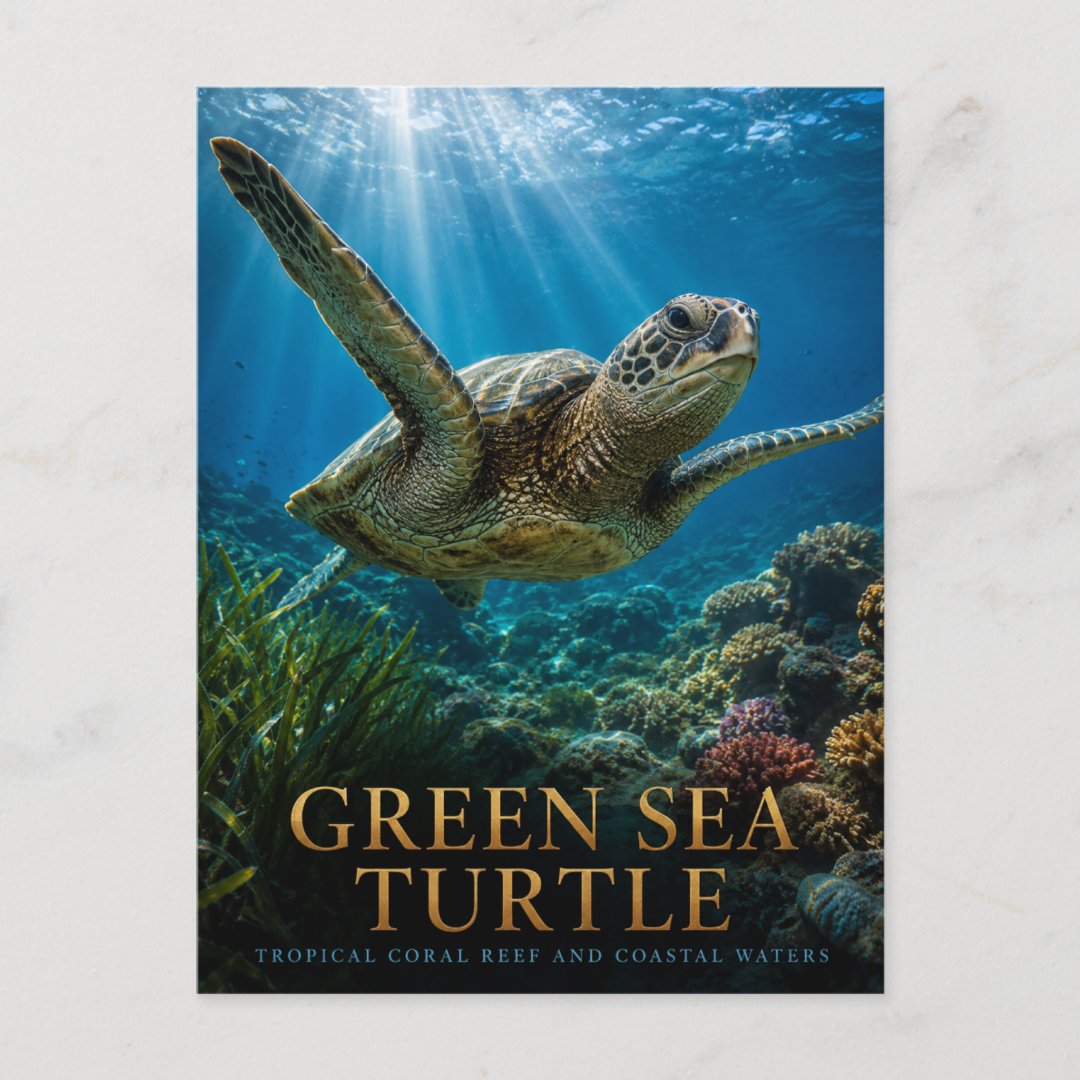
A landmark global reef assessment just hit the wires: the Global Coral Reef Monitoring Network report (released in Palau, covered early September 2026) says coral reefs can no longer recover between bleaching events the way they used to. That is not a beach-nesting cute story — it is a habitat deadline. This post is what that headline means for the animal that grazes the reef by day: the green sea turtle on coral shallows, how its job differs from a leatherback’s jellyfish hunt, and why bleaching news is really a food-web story. The Green Sea Turtle Coral Reef ANIMALS Postcard is one wildlife frame from that workplace, not a claim that every turtle headline is the same species.
The green sea turtle is not named for a green shell
The green sea turtle is Chelonia mydas, one of seven living sea turtle species and the only member of its genus. Adults are named for a layer of greenish fat under the skin. That color comes from a diet of seagrass and algae, not from a jade carapace. The shell of a grown green is usually olive, brown, or mottled. If you are expecting a lime-green pancake, you will walk past the real animal.
Adults commonly reach about 3 to 4 feet in shell length and can weigh 300 to 400 pounds. They are slow to mature and can live many decades. A turtle you see on a tropical coral reef may have been using the same seagrass beds since before the hotel on the beach was built.
The leatherback is Dermochelys coriacea — a different family, a different body plan, a different menu. It is the giant with a rubbery, ridged carapace and no hard scutes. It hunts jellyfish in cold and open water that would starve a seagrass specialist. Same order of reptiles. Not the same job.
Coral reef habitat is a cafeteria, not a backdrop
Green sea turtles use tropical and subtropical coastal waters worldwide. The useful habitat is shallow enough for sunlight. That is where seagrass grows, and seagrass is the adult green’s main crop. A coral reef and a seagrass meadow often sit next to each other. The reef is structure: ledges, rest spots, cleaner fish. The sand flats beside it are the farm. Adult greens crop seagrass blades and take algae off reef rock. The postcard scene of a turtle over mixed coral and seagrass is a feeding map.
Leatherbacks pass through different water. They follow gelatinous prey across basins, dive deep, and come ashore to nest on tropical beaches — including places that make headlines when nesting resumes after a gap. Celebrate that return as leatherback nesting ecology. Do not paste a green reef grazer onto a leatherback press release.
Seagrass jaws versus a jellyfish gullet
Most sea turtles stay closer to a carnivore’s menu. Greens are the odd hard-shelled ones that vote for plants. The lower jaw is serrated for cropping. The gut ferments cellulose. That is why the fat turns greenish, and why the English name stuck.
Leatherbacks keep a soft, pointed snout and a throat built to handle soft prey, with backward-pointing spines that help swallow jellies. They are the cold-water athletes of the turtle world. A green on a reef is a lawnmower with flippers. A leatherback offshore is a jelly specialist the size of a small boat. Confusing them is how recovery news loses its species.
Leatherback versus green — the field marks that settle it
Shell. Green: hard scutes, smooth oval carapace. Leatherback: no hard scutes, seven longitudinal ridges, a teardrop “leather” look.
Size. Greens are large. Leatherbacks are larger still — the largest living turtles.
Head and beak. Greens: rounded snout, serrated lower jaw, usually one pair of prefrontal scales between the eyes. Leatherbacks: softer profile, no scute puzzle on the shell to read like a hard-shell turtle.
Where you are. A calm grazer on a tropical seagrass flat in daylight is almost certainly a green. A huge ridged animal in open water, or a nesting female on a leatherback beach, is the other story. Hawksbills and loggerheads fill other hard-shell niches; they are not leatherbacks either.
Nesting nights versus most of life at sea
The viral sea turtle image is a female on sand, or a hatchling scramble. That is real, and it is a sliver. A female green spends the vast majority of her life in the water. Nesting happens at night, a few times in a breeding season, then often not again for years. Leatherback nesting nights make news because the adults are scarce, huge, and tied to particular beaches — including beaches that can go quiet for years and then host tracks again. Both species live mostly at sea. The beach is a delivery room, not a residence.
Migration: feeding ground to natal beach and back
Green sea turtles commute between foraging grounds and nesting regions, sometimes across entire ocean basins. They navigate with Earth’s magnetic field among other cues. Leatherbacks are long-distance travelers too, but their commute is built around jelly patches and nesting beaches rather than a home seagrass lawn. A still green on a coral reef is a waypoint in a grazing-and-nesting system. A leatherback track on sand is a waypoint in a pelagic jelly system. Same romance of return. Different maps.
Shell and flippers: why that body exists
A green gave up a high tortoise dome for a faired hard shell and winglike flippers. A leatherback went further: lost the hard scute armor, kept ridges, and built a body for deep, cold, long-range jelly work. Neither body is a generic “turtle.” Put the wrong species on the wrong caption and you erase the engineering.
Why the ANIMALS postcard looks the way it does
The Green Sea Turtle Coral Reef ANIMALS Postcard is built from green-turtle natural history, not from a leatherback nesting headline. The low angle looking up is how a grazer sits in the water column over a reef. Seagrass on one side and coral on the other is the adult green’s pair of workplaces. Shafts in tropical shallows are light enough for seagrass to grow. The type says GREEN SEA TURTLE and tropical coral reef and coastal waters because that is the species and the job site — not Dermochelys on a night beach.
Wildlife first. Place as the medium she lives in. That is the ANIMALS line: a cinematic still of a real animal in a real kind of water, meant to be kept, not a stack of SKUs.
Wild Realms makes cinematic wildlife art from the living world. See nature. Feel connection. Cherish forever.
The postcard: Green Sea Turtle Coral Reef ANIMALS Postcard
More green sea turtle wildlife: Sea Turtle collection


Comments
Post a Comment