Don’t take your hummingbird feeder down yet — peak fall migration is now
Don’t take your hummingbird feeder down yet — peak fall migration is now
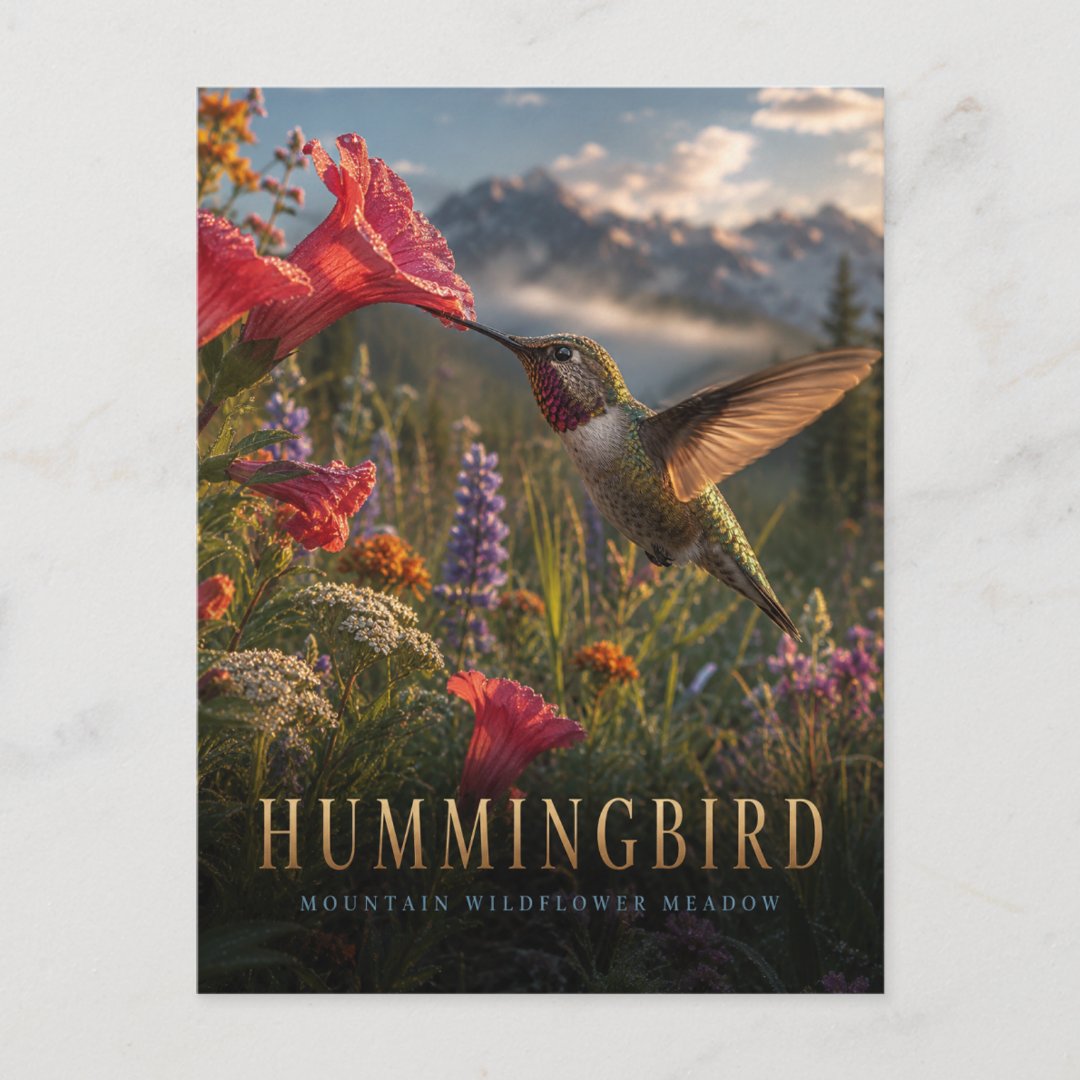
Backyard bird feeds are lighting up this week: outlets are telling people not to take hummingbird feeders down yet because peak fall migration is still running through mid-September. Cornell’s line is the one that matters — a feeder does not “trap” a migrant; it is a fuel stop. This post is what that seasonal argument is really about: how a bird the weight of a coin funds a long southbound flight, why late nectar and insects buy the trip, and how a mountain-meadow hover fits the same energy story. The Hummingbird Mountain Meadow ANIMALS Postcard is one wildlife frame from that migration math, not a calendar myth.
A hummingbird is not a moth that learned to sparkle
Hummingbirds are birds in the family Trochilidae — tiny, fast, and New World. People treat them as flying jewels or as feeder pets. They are not. A hummingbird is a nectar-and-insect specialist with a shoulder joint that allows a wingstroke more like a figure-eight hover than a sparrow’s flap, a heart that races to fund that hover, and a bill matched to flowers it did not invent for your porch. If you are waiting for a songbird perch-and-sing before you will take it seriously, you will miss the animal that can fly backward.
Species differ. Many North American garden visitors are ruby-throated, rufous, Anna’s, black-chinned, and cousins depending on range. The postcard animal is the hummingbird as a meadow worker: iridescent feathers, a hover at a trumpet blossom, mountain wildflowers as the job site. Adults tip the scales at only a few grams. That smallness is the whole engineering problem.
Mountain meadow is a fuel depot, not a backdrop
Hummingbirds use flower-rich openings: alpine and subalpine meadows, forest edges, canyon slopes, desert washes with bloom pulses, and — yes — feeders that imitate those pulses. The useful habitat is nectar timed with insects. Sugar funds the hover. Protein from small insects and spiders funds the body. A meadow in morning light with clustered blooms is a cafeteria map, not scenery for a blur.
Late summer and early fall are when many temperate hummingbirds push south or downslope. Labor Day weekends and end-of-summer gardens feel leisurely to people. To a migrating or staging hummingbird, the same week is logistics: fat, flowers, and weather. A pretty slope with no bloom is a closed kitchen.
Hover, bill, and a metabolism that does not idle kindly
Hovering is expensive. Wingbeats can run tens of times per second. The shoulder anatomy allows lift on both upstroke and downstroke in hover. At rest, many species can enter torpor — a controlled overnight drop in metabolism — because staying warm at hummingbird scale costs more than the night can pay. That is not a nap personality. It is accounting.
The bill and tongue work a flower the way a specialist tool works a lock. Tongue tips spread and mop nectar. Bills match guilds of blooms; not every red tube is a free lunch for every species. Territorial birds defend a patch of flowers or a feeder because the patch is a wage.
Migration on a coin-sized budget
Some hummingbirds cross the Gulf of Mexico in a single nonstop effort. Others island-hop coastlines or follow mountain nectar corridors. The famous number is not magic; it is fat. Before a long crossing, birds load fuel until a tiny body looks almost absurd. Failed timing — cold snap, empty flowers, late start — is expensive. The meadow hover you photograph in September may be a staging bird, not a resident posing for end-of-summer content.
That is the hook worth keeping. Small does not mean local-only. Small means the margin for error is thin.
The viral feeder fight versus most of the day
The image that travels is a bird at a red feeder, or two birds dueling midair. That is real, and it is a sliver. Wild hummingbirds spend long stretches perched, watching, digesting, and making short feeding circuits. Nesting females build tiny cups of plant down and spider silk on sheltered branches. Males display. Insects get caught in midair. If a post only shows the feeder brawl, it is showing the few seconds people stage in a yard. The animal lives in the other minutes among actual flowers and actual air.
Range, seasons, and a moving floral map
A hummingbird’s map is bloom phenology as much as latitude. Mountains push nectar uphill through summer. Deserts pulse after rain. Gardens create artificial constancy that can help or trap depending on timing and species. A still hover at a trumpet flower in a mountain meadow is a waypoint in that moving map — fuel, display, and sometimes migration prep — not a sticker of “tiny bird.”
Why that body exists
A warbler voted for gleaning. A swallow voted for open-air insects. A hummingbird voted for hover economics: dense muscles, a reversible wing stroke, a long bill, iridescence that is structure and angle rather than pigment alone, and a life lived near the edge of its calorie ledger. That is also why a hummingbird without flowers or insects is an animal out of its geometry.
Why the ANIMALS postcard looks the way it does
The Hummingbird Mountain Meadow ANIMALS Postcard is built from that natural history, not from a generic “cute garden bird” template. Flower-height viewpoint is how you actually meet a hover: eye to the blossom, wings as a blur, the meadow stacked behind as the real pantry. Morning light on iridescent feathers and trumpet petals is when color and dew show. Grasses, stems, and alpine green are the job site — a nectar corridor, not a blank sky.
The type on the card says HUMMINGBIRD and mountain meadow because that is the species guild and the workplace. Wildlife first. Place as the medium it feeds in. That is the ANIMALS line: a cinematic still of a real animal in a real kind of bright air, meant to be kept, not a stack of SKUs.
Wild Realms makes cinematic wildlife art from the living world. See nature. Feel connection. Cherish forever.
The postcard: Hummingbird Mountain Meadow ANIMALS Postcard
More hummingbird wildlife: Hummingbird collection


Comments
Post a Comment