Lake County Gray Wolf Sighting Hits California Wires, The Pack Biology Behind the ESA Fight
Lake County Gray Wolf Sighting Hits California Wires, The Pack Biology Behind the ESA Fight
California Department of Fish and Wildlife has confirmed a rare gray wolf presence in Lake County after validating photos and tracks from the Mendocino–Glenn–Lake region, and that local wire arrives on top of a September 4 presidential executive order directing Interior Secretary Doug Burgum to decide within 90 days whether to delist or downlist gray wolves and Mexican wolves under the Endangered Species Act — protections remain in force while the review runs. This post is what those two headlines sit on: where a gray wolf actually lives, how a pack works, why most of its day is travel and rest, and how to tell a wolf from a coyote when the light is bad and the animal will not pose. The Gray Wolf Mountain Wilderness ANIMALS Postcard is one wildlife frame from that story, not the story itself.
The gray wolf is not a German shepherd in a forest
The gray wolf is Canis lupus, the largest wild canid and the ancestor of the domestic dog. People treat “wolf” as a German shepherd with extra attitude. It is not. A wolf is longer-legged, deeper-chested, and built to travel. The face is broader, the ears shorter and more rounded, the tail hangs rather than curling over the back. If you are waiting for a movie snarl before you will say “wolf,” you will mislabel most of the animals you actually see — including the ones that make California news when tracks and photos finally clear a state review.
Adults commonly weigh 70 to 110 pounds in much of North America, heavier in the north, lighter in the south. A coyote is usually 20 to 50. That size gap is real, and it is also the usual trap: a large eastern coyote in winter coat fools people who learned wolves from logos.
Wolves are pack animals that also produce dispersers. A pack is a family, not a street gang. Nomads are wolves too — and a lone or small-group sighting in Mendocino–Glenn–Lake country is often a disperser story before it is a settled territory story.
Mountain wilderness is a job site, not a backdrop
Gray wolves use whatever land still holds ungulates and has enough quiet: boreal forest, mountain valleys, tundra edge, some grasslands, and the mixed woodlands and rangelands of the West where deer and elk still move. The useful habitat is a mix. Prey they can catch. Cover for dens and rendezvous sites. Room to move tens of miles. Snow that does not bury every kill.
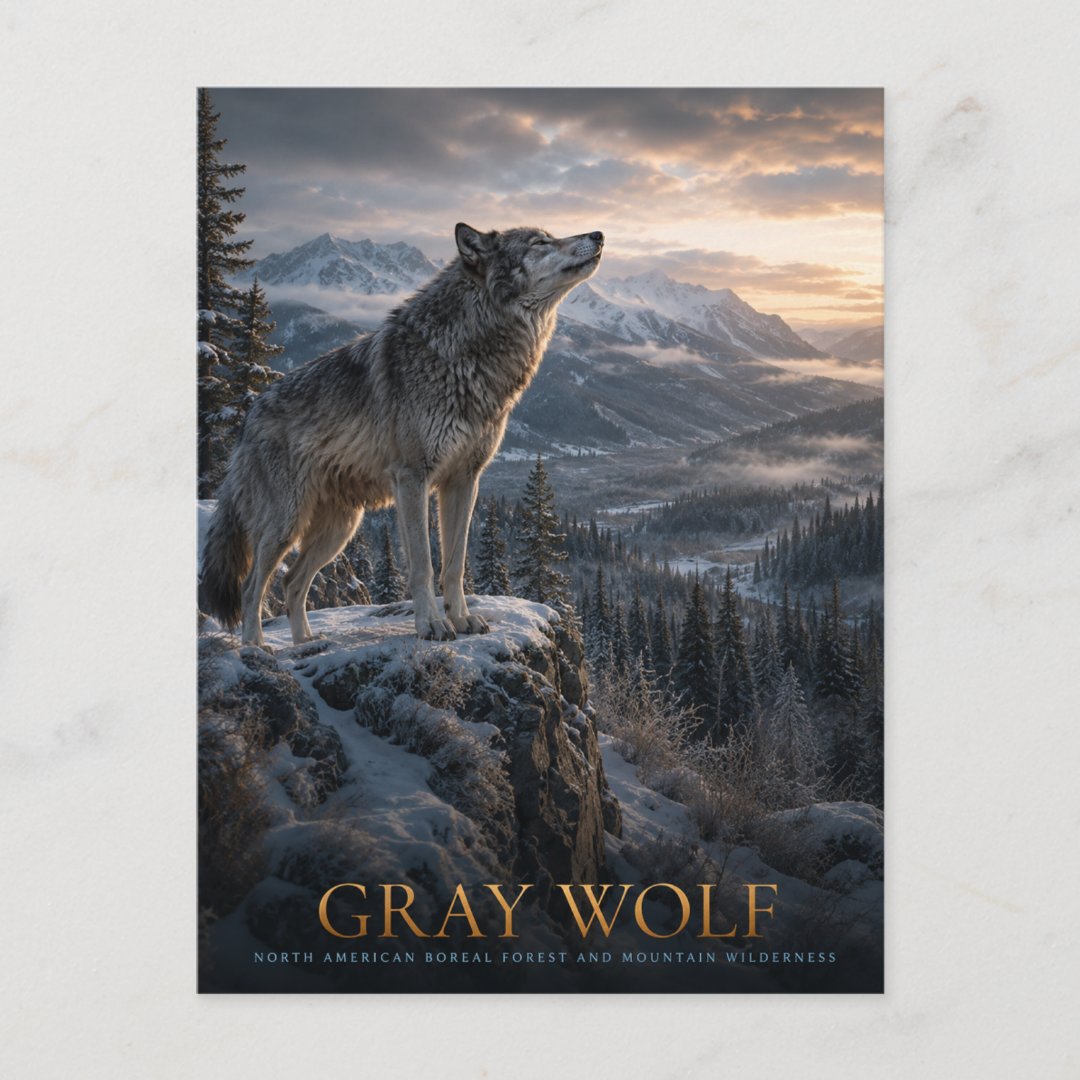
A ridge is not scenery. It is a lookout, a travel line, a wind that carries scent. Evergreen forest below is cover and hunting ground. A snow-dusted saddle is a commute. The postcard pairing of a wolf on a winter ridge above a misted valley is a working map: height for scent and sight, forest for prey, distance a pack can claim.
Wolves do not need a postcard mountain. They do poorly where roads, poisons, and livestock conflict erase the commute between den and kill. A pretty peak with no elk or deer is a closed kitchen. That is why ESA status fights are not only about a howl on a logo. They are about whether the commute still exists when politics changes the label on the map.
Teeth, feet, and why they travel instead of sprinting
Wolves are hypercarnivores built for cooperative hunting of large ungulates: deer, elk, moose, caribou, bison where those still exist, plus smaller prey and scavenged meat. The skull is a killing and feeding tool. The feet are long-distance gear. They do not hunt like a cheetah. They hunt like a family that can walk all day.
A chase is a burst after a stalk or a test of a herd. Failed hunts are expensive. Rest is the budget. A wolf standing still on a cold ridge at first light is often working: scenting, listening, deciding whether the valley is worth the walk.
The pack shares food, not equally in a fairy-tale sense, but as a family with a breeding pair, this year’s pups, and often last year’s young. Dispersers leave to find a vacancy. That is how wolves recolonize country — including fragments of California — not by a single legendary loner starring in a poster.
How to tell a gray wolf from a coyote (and a dog)
The howl is the usual field mark and it is the usual trap if you never see the body. California confirmation work still leans on photos, tracks, and measurements for a reason.
Size and proportion. A wolf is bigger, with longer legs, a larger head, and a chest that looks like it can do miles. A coyote looks slight and fox-lean next to one. A northern dog can overlap wolf size. Then use the next marks.
Ears and muzzle. Wolf ears are shorter and more rounded. Coyote ears look tall and pointed on a narrower face. A wolf’s muzzle is broad. A coyote’s is skinny.
Tail and gait. A wolf’s tail hangs. Many dogs curl or flag. Wolves often travel with a purpose, single-file, a steady lope. Coyotes look springier. Tracks: wolf prints are large, often in a clean direct-register line — the kind of evidence CDFW can validate when a photo alone is ambiguous.
Voice. A wolf howl is long, low, and carries. Coyotes yip and chatter in a higher mix. A single distant howl is not a species ID by itself. Elk bugles have fooled people too.
If you only get a silhouette on a snow ridge at dawn, use bulk, ear shape, and tail carriage before you bet the farm on a movie howl.
The howl and the lone-wolf photo versus most of the day
The viral gray wolf image is a howl, a snarl, or one animal on a rock. That is real, and it is a sliver. Wolves rest a large part of the day. Travel, hunting, and social noise occupy the rest. A howl can carry for miles. It is a location, a rally, a warning, not a personality.
Pups are born in a den, often a dug hole or a borrowed space, and later move to rendezvous sites while adults hunt. A pack is usually a breeding pair, their pups, and some older offspring. Tenure is politics plus food.
If a post or a painting only shows the howl, it is showing the few seconds people can hear from a road. The animal lives in the other 86,400 seconds. The ESA headline is the legal map around those hours; the biology is why the map matters.
Pack behavior: family, territory, and the ESA clock
A pack is a family that holds a territory. Scent marks, howls, and fights maintain it. Territory is about prey, den sites, and other wolves. A ridge is a billboard. The mountain wilderness in the postcard is not empty of politics. It is a property line with spruce on it.
Dispersers are young adults that leave. They travel far. Some find a mate and a gap. Some die. That walk is how the species uses a continent, not a single valley postcard — and how a Lake County confirmation can appear far from the Northern Rockies recovery narrative people already know.
This is why a still gray wolf on a winter ridge is not a small subject. The ridge is a waypoint in a working social system, not a wilderness sticker. The September 4 order’s 90-day Interior review is a civic clock on that system; protections stay in force while the biology under the review keeps walking.
Why that body exists
A fox traded bulk for mouse work. A coyote stayed medium and flexible around people. A wolf voted for long legs, a big engine, and a family hunt of animals larger than itself. Deep chest, snow-adapted feet, a coat that reads as winter timber: the kit of a traveler. Retractable claws are not the story. Mileage is. That is also why a wolf in a tiny enclosure is an animal out of its geometry, and why a confirmed California track line is news even when the animal itself never poses for a postcard.
Why the ANIMALS postcard looks the way it does
The Gray Wolf Mountain Wilderness ANIMALS Postcard is built from that natural history, not from a generic “howling at the moon” template. The wolf is on a snow ridge because that is a real travel and scent line, not because rock photographs well. Cold dawn is when breath and mist show, and when a pack actually moves. Evergreen forest, a broad valley, and far mountains are the job site: prey country with a horizon a family can claim.
The type on the card says GRAY WOLF and MOUNTAIN WILDERNESS because that is the species and the job site. Wildlife first. Place as the medium it lives in. That is the ANIMALS line: a cinematic still of a real animal in a real kind of cold, meant to be kept, not a stack of SKUs.
Wild Realms makes cinematic wildlife art from the living world. See nature. Feel connection. Cherish forever.
The postcard: Gray Wolf Mountain Wilderness ANIMALS Postcard
More gray wolf wildlife: Wolf collection


Comments
Post a Comment