Orcas are dolphins that hunt whales. The name is the lie.
Orcas are dolphins that hunt whales. The name is the lie.
Search “orca killer whale” and you will mostly get a breach, a theme-park grin, or a black-and-white cartoon with no biology attached. This post is the other version: why the largest dolphin is filed under the wrong word, how a toothed hunter takes whales as well as fish, and why “killer whale” is a name that flipped the job. The Orca North Pacific Fjord ANIMALS Postcard is one wildlife frame from that story, not the story itself.
The orca is not a generic whale with extra teeth
The orca is Orcinus orca, the largest living oceanic dolphin, family Delphinidae, not a baleen whale that grew a grudge. People treat “whale” as one dark back. It is not. An orca is a toothed hunter with a white eye patch, a paddle of a pectoral, and a dorsal fin that on a big male can stand like a door. If you are waiting for baleen and a gulp, you will walk past the animal that actually kills whales.
Adults commonly reach 16 to 26 feet, males larger, with that tall fin and a heavier stem. Females and young have a smaller, more curved dorsal. A calf is already the size of a real dolphin and still dependent. Orcas live in matrilines. Mothers, sisters, and offspring travel, hunt, and share a dialect. That is work, not a choir for a rail.
They occur in every ocean. The North Pacific fjord on the card is one job site among many.
Cold coastal water is a job site, not a backdrop
Orcas use coasts, fjords, and open water wherever prey concentrates. In the North Pacific that includes the Salish Sea and San Juan Islands, the Outer Coast, southeast Alaska, British Columbia inlets, and deeper water beyond the shelf. The useful habitat is prey they can find with sound and a surface they can meet for air. A fjord is a hallway. A kelp line is a wall. A tide rip is a door.
A blow against dark water and timbered cliffs is not scenery. It is a marine mammal clocking in. Fish-eating residents work salmon runs and the acoustic clutter of inshore water. Mammal-eating Bigg’s orcas work the same coasts for seals, sea lions, porpoises, and the occasional whale. The postcard pairing of a surfacing animal, spray from the blowhole, steep forested walls, snow on a far ridge, and low sun in the mist is a working map: air at the top of the breath, food somewhere in the next inlet, a horizon a matriline can commute along.
They do poorly where salmon collapse, where boat noise erases the click, and where contaminants load the fat of a long-lived hunter. A pretty fjord with no fish and no quiet is a closed kitchen.
Teeth, sound, and a hunt that is culture
Orcas have conical teeth, not baleen. The method is bite, tear, drown, or exhaust, depending on the prey and the culture of the group. Echolocation clicks map the water. Calls keep a matriline together. Failed hunts are expensive. A warm-blooded hunter in cold water has a bill.
Diet is not one menu. Some populations are salmon specialists. Some take marine mammals. Some work offshore fish and sharks. Calves learn the job from the line they are born into. A technique that works on a gray whale calf is not the technique that works on a chinook. Rest at the surface between searches is the budget. A still orca in a fjord, blowing, is often between attempts, not posing.
Cooperative hunting is a family that has rehearsed the same water for decades. A postcard orca can look solitary because the rest of the matriline may be a ridge of fins just out of the crop.
They are dolphins that hunt whales. The name is the lie
Call it a killer whale and you have already lost the plot. The English name is a rearrangement of an older idea: a whale killer, an animal that takes whales. Spanish asesina ballenas said the same thing before the words got flipped into a species of whale that kills. The animal is an oceanic dolphin. The victims, when the culture hunts that way, are whales.
They take minke whales. They take gray whale calves on migration. They have been recorded on humpbacks, on other dolphins, on the marine mammals that share a fjord. Not every orca does this. Fish-eating residents of the Salish Sea are not in the whale-killing business. Mammal-eating Bigg’s orcas are. The species still wears a name built from the hunters. The lie is the noun. People hear “whale” and picture a mystic gulp-feeder. They are looking at a dolphin with a business in other whales.
Taxonomy is not a vibe. Delphinidae is the dolphin family. The genus is the largest living member of that family. Pilot whales and false killer whales are cousins in the same general neighborhood: toothed, social, and badly named. If the postcard only said “whale,” it would be repeating the filing error. ORCA is the correction. The fjord is where that correction still hunts.
The breach and the movie villain versus most of the day
The viral orca image is a full-body breach, a spyhop at a rail, or a theme-park animal in a tank. That is real in the limited sense that breaches happen and tanks existed. It is a sliver. Orcas spend most of their lives as dark shapes under a swell, traveling, clicking, missing, trying again. A breach can be display, play, a look, or a way to move water off the body. It is a decision, not a personality.
Most of the day is commute. Inshore groups work tides and the salmon calendar. Mammal-hunters cover more water for fewer, fatter meals. Calves nurse for more than a year and stay in the line. If a post or a painting only shows the breach, it is showing the two seconds people can film from a boat. The animal lives in the other 86,398 seconds, many of them spent as a black back in a fjord, moving toward the next fish, the next seal, or the next whale the culture knows how to take.
Oceans, matrilines, and a commute the size of a coast
Orcas are among the most widely distributed mammals on Earth: polar edges, temperate coasts, tropics in some forms. The North Pacific postcard is a local room in a global house. Southern Residents of the Salish Sea are not the same culture as Alaska mammal-hunters or offshore groups. Photo-ID of saddles and fins is how catalogs of individuals get built. A “mystery whale” off Friday Harbor is often a known animal with a known mother.
A still orca in a North Pacific fjord, with spray and a timbered wall, is not a small subject. The water is a waypoint in a working hunting system, not a cruise backdrop.
Why that body exists
A humpback voted for a gulp and a long commute on krill. A great white voted for a cutting bite from below. An orca voted for teeth, sound, a family that teaches the hunt, and a body that can take a salmon or a whale calf depending on which culture it was born into. The tall male fin is a signal as much as a keel. The white patch is a field mark and a flash in dim water. The whole skeleton voted for range and for killing at the scale of a dolphin that outgrew the word. That is also why an orca in a tank is an animal out of its geometry.
Why the ANIMALS postcard looks the way it does
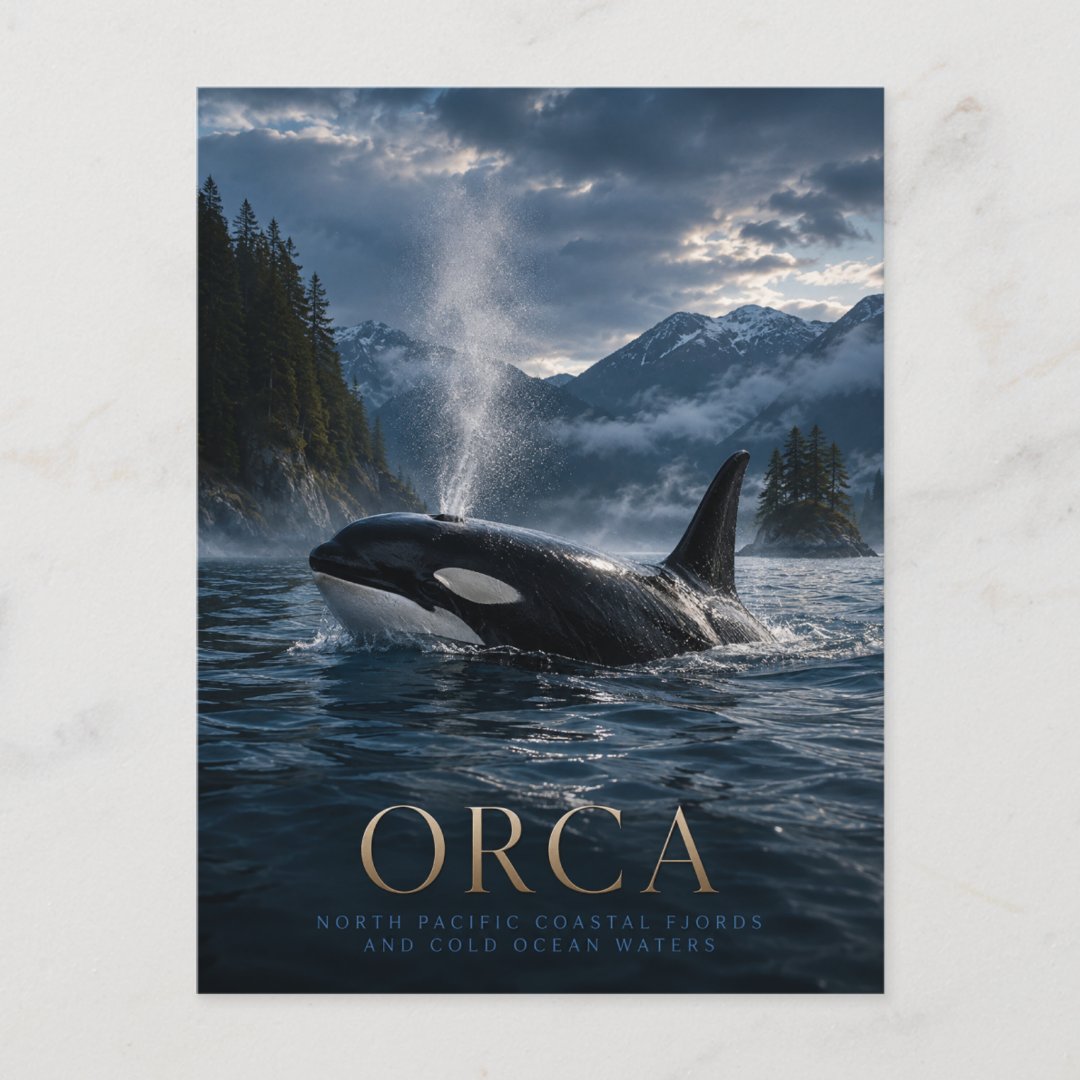
The Orca North Pacific Fjord ANIMALS Postcard is built from that natural history, not from a generic “happy splash” template. The animal is at the surface, blowing, because that is a real working second in a life of commuting under the fjord, not because jumping photographs well. A near-water-level view is scale: head, patch, dorsal, spray, and an inlet still larger than the breath. Steep forested walls, snow on a far ridge, mist on the water, and low sun warming the blow are the job site. Bright edges on wet black skin are when a surfacing dolphin actually shows.
The type on the card says ORCA and NORTH PACIFIC COASTAL FJORDS AND COLD OCEAN WATERS because that is the species and the job site. Wildlife first. Place as the medium it lives in. That is the ANIMALS line: a cinematic still of a real animal in a real kind of water, meant to be kept, not a stack of SKUs.
Wild Realms makes cinematic wildlife art from the living world. See nature. Feel connection. Cherish forever.
The postcard: Orca North Pacific Fjord ANIMALS Postcard
More orca wildlife: Orca collection


Comments
Post a Comment