Plains Zebra East African Savanna Habitat, Stripes, and How to Tell Them Apart
Plains Zebra East African Savanna Habitat, Stripes, and How to Tell Them Apart
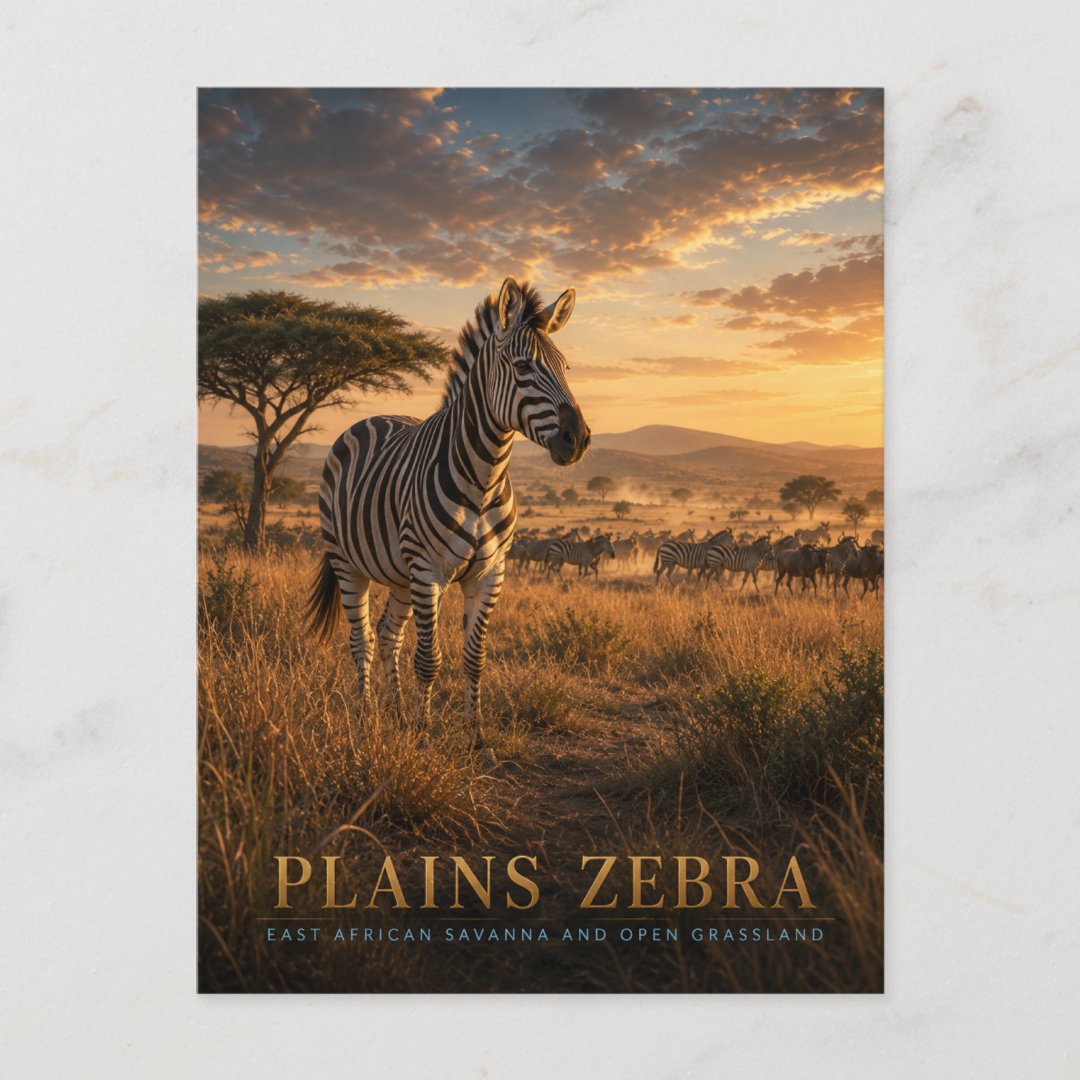
Search “zebra savanna” and you will mostly get a crossing, a foal, or stripes with no biology attached. This post is the other version: where a plains zebra actually lives, how a herd is organized, why the stripe pattern is an ID card as much as a mystery, and how to tell this species from Grevy’s zebra, a mountain zebra, or a horse when the light is bad and the animal will not pose. The Plains Zebra East African Savanna ANIMALS Postcard is one wildlife frame from that story, not the story itself.
The plains zebra is not “the zebra”
The plains zebra is Equus quagga, the widespread striped equid of East and southern African grassland, also called Burchell’s zebra in older books. People treat “zebra” as one barcode on a safari mug. It is not. Grevy’s zebra is a different species, built for drier north-Kenyan and Ethiopian country, with narrower stripes and mule-like ears. The mountain zebra is a different species again, a Cape and Namibian highland animal with a grid of stripes on the rump. The extinct quagga was a plains zebra with the stripes faded off the hindquarters.
Adults commonly stand about 4 to 5 feet at the shoulder and weigh 400 to 700 pounds. They are horses in the broad sense: odd-toed ungulates with a hindgut that ferments grass. Plains zebras are herd animals that also produce bachelor groups and, in a few systems, enormous seasonal aggregations.
East African savanna is a job site, not a backdrop
Plains zebras use grassland and open woodland from East Africa through much of the south: Serengeti-Mara, Kruger, and unprotected plains in between. The useful habitat is grass they can crop, water within a walk, and eyes-up country where a lion is a problem you can see coming.
An acacia is not scenery. It is shade, a landmark, and sometimes browse when grass is poor. Tall golden grass is cover for predators and a cafeteria for a grazer that takes the coarser stems wildebeest often leave. A low hill is a lookout. The postcard pairing of one zebra in late light, with a distant herd between trees and haze, is a working map: forage underfoot, company on the horizon, room to move as the season dries.
They do poorly where fences cut the walk between grass and water, or where livestock and cultivation erase the sward they actually use. A pretty sunset over empty dust with no drink is a closed kitchen.
Teeth, gut, and why stripes are an ID, not a logo
Zebras are grazers. The incisors clip. The molars grind silica-rich grass until they wear down over a lifetime. The hindgut ferments what a cow would send through a rumen. They drink often when they can. Much of the day is head-down work, interrupted by the head-up scan that makes the postcard animal look “alert,” which is a polite word for not wanting to be lunch.
Every plains zebra’s stripe pattern is unique. Researchers use it the way they use humpback flukes: as a catalog. Foals can be matched to mothers. Individuals can be followed across years. That is the least mystical fact about stripes and the most useful. The evolutionary “why” is still an argument: disruption in a moving herd, a social signal, a worse landing strip for biting flies. You do not have to pick a winner to use the pattern as a name tag. A zebra standing slightly apart in golden grass is still wearing a face that no other zebra has.
How to tell a plains zebra from Grevy’s, mountain zebras, and horses
The stripes are the usual field mark and they are the usual trap if you stop at “black and white.”
Stripe width and belly. Plains zebra: relatively broad stripes, often with shadow stripes in southern animals, and stripes that typically meet under the belly. Grevy’s: many narrow stripes, a white belly, a black dorsal stripe, and a look closer to a mule designed by a technical pen.
Ears and build. Grevy’s has large, rounded ears and a heavier, more ass-like frame. Plains zebra ears are smaller and more horse-ordinary. Mountain zebra: a dewlap under the throat and a “gridiron” of short transverse stripes on the rump.
Place. Serengeti, Mara, a typical East African mixed herd with wildebeest: plains zebra. Northern Kenya dry country with skinny stripes and huge ears: think Grevy’s. Cape mountain fynbos or Namib escarpment: mountain zebra. A domestic horse with painted stripes is still a horse. If you only get a silhouette in dust at last light, use ear size, stripe density, and whether the belly is barred before you bet the farm on a cartoon.
The road-crossing photo versus most of the day
The viral plains zebra image is a herd on a road, a foal’s first steps, or an optical-illusion jumble of stripes. That is real, and it is a sliver. Zebras graze a large part of the day. Walking between swards, watching, dust-bathing, and the small violence of stallion politics occupy the rest. A freeze in tall grass with ears forward is work: something moved in the heat shimmer. It is not a pose.
If a post or a painting only shows the crossing, it is showing the ten seconds a vehicle can stop. The animal lives in the other 86,390 seconds, many of them spent with the head down in grass that does not care about your camera.
Herds, harems, and the long walk of the migration
A typical plains zebra social unit is a harem: one stallion, several mares, their foals and yearlings. The stallion defends the group more than a patch of dirt. Bachelor males live in their own noisy clubs and wait for a vacancy or a fight they can win. In the Serengeti-Mara system those small families join a seasonal river of grazers. Wildebeest get the headlines. Zebras are often ahead of them, taking the taller, coarser grass. That is two digestive systems dividing a plain, not courtesy.
Range is about grass, water, and other zebras. The East African savanna in the postcard is not empty of politics. It is a property line with dust on it. This is why a still plains zebra in late light is not a small subject. The pause is a waypoint in a working herd system, not a safari sticker.
Why that body exists
A horse voted for speed on grass and a partnership with people. An ass voted for dry country and long ears. A plains zebra voted for the open African sward with predators still in it: a gut that can take coarse grass, a body that can run, and a coat that turns a herd into a moving argument for any lion trying to pick one animal. Hooves, not pads. Eyes on the side of the head. The whole skeleton voted for the savanna job: walk, crop, watch, join the others when the grass ahead is better. That is also why a zebra in a tiny paddock with no horizon is an animal out of its geometry.
Why the ANIMALS postcard looks the way it does
The Plains Zebra East African Savanna ANIMALS Postcard is built from that natural history, not from a generic “stripes at sunset” template. The zebra is paused in tall golden grass, head up and ears forward, because that is a real working second: the scan between bites, not a studio stance. Eye level is how a herd animal sits in its own grass. A distant herd, scattered acacias, low hills, dust, and late-day haze are the job site: forage country with a horizon a family can cross. Golden light is when stripes actually read as volume instead of a flat barcode, and when the savanna’s layered heat shows distance.
The type on the card says PLAINS ZEBRA and EAST AFRICAN SAVANNA because that is the species and the job site. Wildlife first. Place as the medium it lives in. That is the ANIMALS line: a cinematic still of a real animal in a real kind of grass, meant to be kept, not a stack of SKUs.
Wild Realms makes cinematic wildlife art from the living world. See nature. Feel connection. Cherish forever.
The postcard: Plains Zebra East African Savanna ANIMALS Postcard
More plains zebra wildlife: Zebra collection


Comments
Post a Comment